

 fandom
or, “W.D. Gaster undercuts Undertale’s cohesiveness as a work”
Something I struggle with as a writer is how to write fiction that’s deep and meaningful.
When a very young Gio wrote The Raphael Parable, I updated it with a little ARG. “The ARG Update”, I called it. There were scattered clues, and a puzzle, and secret notes so the diligent scavenger could piece together what really happened. Except nothing did really happen. There wasn’t a story I wanted to tell, there wasn’t an interesting mystery to solve, there were just clues tied to more clues tied to an arbitrary ending. It was hopefully fun to follow, but it was the trappings of mystery without any of the meaning.
The other stories I loved were much better at this. Petscop has a substantial depth to it because it keeps tying itself to reality. The viewer is given a real person recording themselves playing a game. It’s set in our world. The game itself seems to be intricately tied to real-world events; too. Disappearances, the player’s family, even the YouTube account managing the videos. Petscop tells a deep mystery story because the mystery is backed by a story: a death, an abuse, a revenge. There’s meat to the mystery.
Sans (Undertale) is a fun character. He’s spooky. He breaks an unbreakable log, he teleports, he’s figured out something about the timelines. Then there’s a fight with Sans, where he’s very tough and has a gun.
Then he needed a backstory for his gun and science, and we got Gaster, who is almost those things. Gaster was a fun idea, though, so he got some extra Easter eggs. We get room_gaster, the gaster followers, Mysteryman, the wrong number song, and the sound test. He’s fun, and mysterious, and ended up carrying most of the mysterious lore bits of Undertale that were never quite explained.

This is an emergent1 story, not one Gaster was crafted around. This is the narrative that arises out of Gaster’s mechanical function of… well, not being there. This is all intentional esotericism. Gaster is defined by his absence; he’s a character based on themes of cut and redacted content who leaves a hole in the world. Discovering these strands (as the game means for you to do!) creates an emergent narrative: what’s at the end of this last string?
Regardless of his origin, Undertale places importance on Gaster in multiple visible ways:
- Calling out his importance mechanically (if you enter his name, it crashes the game)
- Calling out his importance narratively (he’s behind the True Lab, Sans, Alphys)
- Providing a trail of clues and information in the form of random events, follower encounters, stat blocks, etc.
So, who is W.D. Gaster? Who is the big backstory, the Secret, the man behind the True Lab? Nothing. He’s the previous royal scientist, but through some unknowable horror he got deleted from reality. “Shattered across time and space”, according to another character who doesn’t seem to exist. He’s cut content who was conceived of as cut content. He’s a mystery by definition. The only story he gets is one of omission, the vague cosmic horror of not existing:
Have you ever thought about a world where everything is exactly the same… Except you don’t exist? Everything functions perfectly without you… Ha, ha… The thought terrifies me.
– still not Gaster, because he isn’t there
Treating Gaster as a solvable mystery is an explicitly absurd quest in futility. He is unfixable. The answer is missing. The string does not have an end at all.
But Undertale isn’t about mysteries, not really. Undertale shames the genocide completionist and teases the pacifist stickler. Undertale wants you to move on from Undertale.
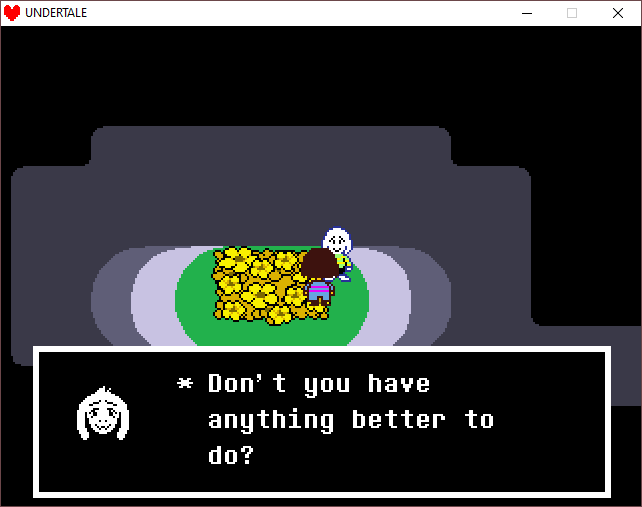
Undertale doesn’t want you to sit down at a corkboard and “solve” it. W.D. Gaster refuses to be solved. His whole character is defined by being missing, by not being in the game or even in the universe at all.
And yet.
And yet Gaster demands solution. There’s just too much riding on it. With every ounce of weight Undertale gives to its plot, with every secret detail it includes about Gaster, it demands you care about him. He designed the SOUL machine that kickstarts the whole plot of the game. He gives Sans the knowledge he needs to nudge the timelines toward safety. He is all the loose ends and plot holes wrapped up into one character who isn’t available to be interrogated.
This isn’t like with the genocide route, where the player is shamed for starting a rampage for the sake of it. In the genocide route, the game’s mechanics form a possibility, and the player can pursue that gap and find the logical consequence of their actions. With Gaster, the game’s story includes this key, esoteric character that the game teases but does not resolve. The player can pursue this gap and find more teasers, finding the outline of a gap, but there is no conclusion to be found at all. This is a mystery the game created, a mystery the story revolves around. The player is demanded to consider it, to solve it, to work towards solutions. But in the end they’re denied a solution. There’s a missing piece, and there always will be.
In a parallel to the way Asriel wants you to keep playing the game to the point of self-destruction, Undertale wants you to keep solving its story to that same end. This is Undertale deliberately hooks you into doing, not an expectation the player unfairly imposes on the work.
I’m forcefully reminded at this point about Folding Ideas’ excellent video The Stanley Parable, Dark Souls, and Intended Play, which makes this argument:
If there is crafted content on the other side of your misbehaviour, then it’s not actually misbehaviour.
…
If there is something that the game’s author simply flat-out, 100% did not want you to experience, did not want you to engage in, then it wouldn’t be there. Even when it comes to potential misbehavior using the rules of the system you’re placed within, externalities that they didn’t or couldn’t account for, like throwing garbage at NPCs, the only truly accurate sign that the authors don’t want you doing that is that nothing happens at all. This is because even a negative reaction, even the game pushing back against misbehaviour, is content.
The obvious example of subversively intended play is the genocide route, but I can’t help but think of the contrapositive alluded to in the quote above. If there is nothing, no content behind a path, then the game is making the strong, deliberate statement that it does not want you following that path. Gaster, a character defined by a lack of content, is then a whole degree of judgment further than the genocide route — maybe even the harshest a game can possibly discourage something. How viciously then must Undertale want you to not think about this? This intensity around the character from the game only adds more weight and importance to the question.
But — for me, at least — this paradoxically creates a weird illusion of depth. The mystery being intricate, having scattered clues throughout the game, being tied to characters and mechanics I’ve learned to love through playing it… it all makes it feel important. Fun values and random events make the game feel “deeper”, like there’s a vast world you’re getting inconsistent glimpses into, and Gaster seems to be presented explicitly as a secret that takes digging to discover. Digging is explicitly encouraged with more content and tidbits and clues.
And as you learn the puzzle is harder and harder to solve, as the clues become scattered so far throughout the game world and tied so deeply to the plot and characters, the “answer” feels more and more important. It’s an illusion. A trick. A sleight-of-hand. There’s no depth, no substance to it. Just signs and symbols of depth around an answer that isn’t. We know the answer isn’t deep or important because — by definition — there is not an answer at all.
I say it “undercuts Undertale’s cohesiveness as a work” because again, I think Undertale wants to be set down and for the player to be finished with it. But Gaster simultaneously hooks the dedicated player into an unfinishable puzzle.
The Gaster mystery is the kind of thing you have to seal away in a glass box, or else it doesn’t work. It’s a mystery you can’t treat as a mystery. It’s an ouroboros. Despite the act of eating and the concept of body length being things that demand concrete resolution, it’s not a resolvable thing. You can’t finish it, you can’t resolve it. You can only abstract it and understand it for what it is.
I love W.D. Gaster. The mystery of omission is incredibly tantalizing to me, on a deep level. I want to dive in, I want to solve this character. I want to look at the science, and find all the secret grey kids, and piece together every last crumb of the universe. I stayed up until midnight to get the survey program that turned out to be Deltarune, and I was disappointed when it did. I wanted more pieces of the puzzle, not more puzzle. W.D. Gaster is always the promise of more puzzle, but without the solution. The solution isn’t just missing, it’s impossible. The mystery itself is predicated on it not itself being solvable. I hate W.D. Gaster.
Related reading:
- /u/Karibil_Watar, Further Stratifying Gaster and Sans Development
- Folding Ideas, The Stanley Parable, Dark Souls, and Intended Play
- hbomberguy, Perverted Sentimentality: An Analysis of UNDERTALE
- Adam Millard, What Was Undertale Actually About?
- The Unbearable Now: An Interpretation of The Witness
- Jacob Geller, “The Decade-Long Quest For Shadow of the Colossus’ Last Secret”
.jpg) Oh. There is a man here.
Oh. There is a man here.
-
/u/Karibil_Watar wrote an analysis theorizing that, based on the order in which objects were added to the game, Sans was written first, and Gaster was written as an addition later.
Now that we know more about Deltarune, the above sequence of events is only one possibility. If Deltarune was planned first, and Gaster was an integral character in that story, he could have been developed as a character prior to Undertale. The references to him were still added in last, but this could have also been for thematic reasons. ↩