Tagged: api

OS-Level Age Attestation is the Good One

  • Posted in cyber

There’s a coordinated effort to use the “child safety” euphemism to cripple the internet with identity verification mandates. That’s bad. But buried in the mix there’s a genuinely good idea with enough political capital that it might stick around and do some good.

Every time I’ve tried to write an article on the topic of child internet safety my energy has fizzled into depression, because as one researches the topic it becomes obvious that everyone with any relevant power is refusing to solve the problem on purpose. It’s demoralizing and it’s been mostly useless for me to do any thought work in this area.

But California’s age attestation bill might be an exception to this. Because it’s age attestation, not age verification, it looks like a significant political step in the right direction, and with the right focus it could do a lot of good. A lot of people have (fairly!) assumed attestation was age verification or at least lays the groundwork, but I think this isn’t the case. There is always the danger of future bad legislation, but OS attestation doesn’t pave the way for it, it provides a strong defense against it. We need a good idea to win the child safety war, not because we’re in dire need of more online child safety, but because addressing the real concerns correctly blocks a whole slew of impossibly dangerous policies.

My ideal age filtering tool is a system of client attestation with trust rooted in the adult administrator, provided by an OS-level API provided as preemptive verification, enforced by compliant browsers and application stores. And we’re shockingly close to that.

There is room for improvement

People on the privacy side of the age verification war — my side — will argue that parents already have everything they need for comprehensive web filtering if they want to use it. I think this isn’t quite true; there’s one notable architectural gap that a technical solution could meaningfully fill.

There are many existing content filtering tools geared toward child safety but their weakness is that they’re reactive. Traffic filters can identify and block traffic from known websites and on-device content filters can try to detect and block specific content. But this requires the user reacting and defending against every possible source and behavior. It’s the same cat-and-mouse game as adblockers. And like adblockers, the more closed down the system is — like iOS or gaming consoles — the harder it is for developers to make exactly the right product.

The internet sometimes assumes minors are supervised — since they have parental consent to have the device in the first place — but this often isn’t the case. It’s very common for minors to have their own phones or tablets with unsupervised access. When they’re online or downloading apps, they’re not sitting with a parent, they’re unsupervised, roaming children. Parents are dropping their kids off in the city.

This isn’t inherently bad; it seems like parents and children both want children to be able to exist independently without granular supervision, and so there’s a desire to make that situation safer. That shouldn’t come at the cost of any adult liberty or even the liberty of children with parental consent; it just means we want an ecosystem that allows for unsupervised children to exist within it.

Right now the burden is on parents to be active defenders protecting their children from a vast ecosystem of companies investing research and capital into optimizing how efficiently they can exploit money and data out of everyone in the world. It would be a meaningful improvement if there were a safe way to prevent some of this exploitation by putting reasonable requirements on providers, so long as this can be done in a way that doesn’t cause more problems.

Political pressure for “child safety” is exploitable

But the lack of a perfect parental control system isn’t the main problem here. The real danger is the push for online identity verification using child safety as a justification.

Smart and privacy conscious people demand “No age verification” (quite reasonably!), but that doesn’t offer the quick fix people are looking for. More importantly, it doesn’t relieve the political pressure and so doesn’t take away the excuses of tyrants.

Normally “do nothing” would be the safest option here, but the danger of uninformed and reactionary voters means there is a great deal to gain by satisfying the concerns safely instead of letting the solution be evil. A technical standard for parents to somehow identify their children as children is the relief valve for dangerous political pressure. This doesn’t appease the fascists and censors. This doesn’t cede them any ground and it’d be wrong to try to; there’s no satisfying that hunger and it’s a dangerous mistake to feed it. What it does is actually improve the material conditions for the people they’re trying to trick.

A proactive system that puts some of the burden for protecting children on those companies is a real relief to this, and it would be a meaningful improvement if something could address this without causing bigger problems.

Taxonomy

There are three basic categories of age filtering: nothing, client attestation, and client verification. These provide services varying levels of confidence in their knowledge of users. (It’s tempting to simplify confidence to labels like “strong” or “weak” but it’s important to think about what’s actually being secured, and from who.) Different people call these different things, but here’s my taxonomy with the labels I’ll use.

Fake Twitter accounts

  • Posted in cyber

Remember when Elon Musk was trying to weasel out of overpaying for Twitter? During this very specific May 2022-Jul 2022 period, there was a very artificial discourse manufactured over the problem of “fake accounts” on Twitter.

The reason it was being brought up was very stupid, but the topic stuck with me, because it’s deeply interesting in a way that the conversation at the time never really addressed.

So this is a ramble on it. I think this is all really worth thinking about, just don’t get your hopes up that it’s building to a carefully-constructed conclusion. ;)

Argument is stupid

First, to be clear, what was actually being argued at the time was exceedingly stupid. I’m not giving that any credit.

After committing to significantly overpay to purchase Twitter with no requirements that they do due diligence (yes, really!) Elon Musk tried to call off the deal.

This was a pretty transparent attempt to get out of the purchase agreement after manipulating the price, and it was correctly and widely reported as such.

Scott Nover, “Inside Elon Musk’s legal strategy for ditching his Twitter deal”

Elon Musk has buyer’s remorse. On April 25, the billionaire Tesla and SpaceX CEO agreed to buy Twitter for $44 billion, but since then the stock market has tanked. Twitter agreed to sell to Musk at $54.20 per share, a 38% premium at the time; today it’s trading around $40.

That’s probably the real reason Musk is spending so much time talking about bots.

I don’t want to get too bogged down in the details of why Elon was using this tactic, but fortunately other people wrote pages and pages about it, so I don’t have to.

Reddit: Your API *IS* Your Product

  • Posted in cyber

Reddit is going the same route as Twitter by making “API access” prohibitively expensive. This is something they very famously, very vocally said they would not do, but they’re doing it anyway. This is very bad for Reddit, but what’s worse is it’s becoming clear that companies think that this is a remotely reasonable thing to do, when it’s very critically not.

It’s the same problem we see with Twitter and other late-capitalist hell websites: Reddit’s product is the service it provides, which is its API. The ability for users to interact with the service isn’t an auxiliary premium extra, it’s the whole caboodle!

I’ll talk about first principles first, and then get into what’s been going on with Reddit and Apollo. The Apollo drama is very useful in that it directly converts the corporate bullshit that sounds technical enough to make sense into something very easy to understand: a corporation hurting them, today, for money.

The API is the product

Reddit and all these other companies who are making user-level API access prohibitively expensive have forgotten that the API is the product. - The API is the interface that lets you perform operations on the site. The operations a user can do are the product, they’re not auxiliary to it!

“Application programming interface” is a very formal, internal-sounding term for a system that is none of those things. The word “programming” in the middle comes from an age where using a personal computer at all was considered “programming” it.

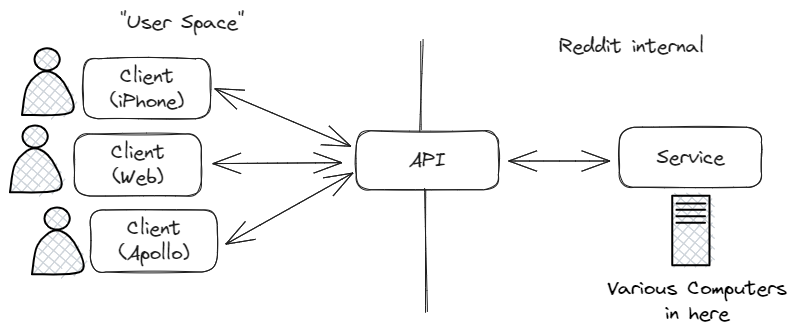
What an API really is a high-level interface to the web application that is Reddit. Every action a user can take — viewing posts, posting, voting, commenting — goes from the app (which interfaces with the user) to the API (which interfaces with the Reddit server), gets processed by the server using whatever-they-use-it-doesn’t-matter, and the response is sent back to the user.

The API isn’t a god mode and it doesn’t provide any super-powers. It doesn’t let you do anything you can’t do as a user, as clearly evidenced by the fact that all the actions you do on the Reddit website go through the API too.

The Reddit website, the official Reddit app, and the Apollo app all interface with the user in different ways and on different platforms, but go through the same API to interact with what we understand as “Reddit”. The fact that the API is the machine interface without the human interface should also concisely explain why “API access” is all Apollo needs to build its own app.

Right now, you can view the announcement thread at https://www.reddit.com/r/apolloapp/comments/144f6xm/apollo_will_close_down_on_june_30th_reddits/, and you can view the “API” data for the same thread at https://www.reddit.com/r/apolloapp/comments/144f6xm/apollo_will_close_down_on_june_30th_reddits.json. It’s not very fun to look at, but it’s easy to tell what you’re looking at: the fundamental representation of the page without all the trappings of the interface.

Public APIs are good for both the user and the company. They’re a vastly more efficient way for people to interact with the service than by automating interaction (or “scraping”). Having an API cuts out an entire layer of expense that, without an API, Reddit would pay for.

The Reddit service is the application, and you interface with it through WHATEVER. Whatever browser you want, whatever browser extensions you want, whatever model phone you want, whatever app you want. This is fundamentally necessary for operability and accessibility.

The API is the service. The mechanical ability to post and view and organize is what makes Reddit valuable, not its frontend. Their app actually takes the core service offering and makes it less attractive to users, which is why they were willing to pay money for an alternative!

Twitter Blue is a late-stage symptom

  • Posted in cyber

Twitter Blue! $5/mo for Premium Twitter. It’s the latest thing that simply everyone.

News articles about twitter blue

I have an issue with it, but over a very fundamental point, and one Twitter shares with a lot of other platforms. So here’s why it’s bad that Twitter decided to put accessibility features behind a paywall, and it isn’t the obvious.

Client/Server architecture in 5 seconds

All web services, Twitter included, aren’t just one big magic thing. You can model how web apps work as two broad categories: the client and the server. The client handles all your input and output: posts you make, posts you see, things you can do. The server handles most of the real logic: what information gets sent to the client, how posts are stored, who is allowed to log in as what accounts, etc.