

 cyber
cyberEverybody hates paying subscription fees — at this point most of us have figured out that recurring fees are miserable. And we’re right! But it’s worth sitting down and thinking through the problem, because it isn’t just “paying people money means less money for me”. Subscriptions in particular have become particularly unfair and exploitative, in a way that’s a fundamental attack on what payment and ownership even are.
Human Agency: Why Property is Good
or, “Gio is not a marxist, or if he is he’s a very bad one”
First: individual autonomy — our agency, our independence, and our right to make our own choices about our own lives — is threatened by the current digital ecosystem. Our tools are powered by software, controlled by software, and inseparable from their software, and so the companies that control that software control us. When software defines our lives and companies have the power to regulate that software, they have the power to control us.
Lawrence Lessig is well known for his observation that code forcibly regulates behavior. As he predicted in his original 2000 essay Code Is Law: On Liberty in Cyberspace1:
Lawrence Lessig: Every age has its potential regulator, its threat to liberty…. Ours is the age of cyberspace. It, too, has a regulator. This regulator, too, threatens liberty. …This regulator is code – the software and hardware that make cyberspace as it is. Cyberspace will change from a place that protects anonymity, free speech, and individual control, to a place that makes anonymity harder, speech less free, and individual control the province of individual experts only.
This final sentence has proven to be particularly prophetic, except that control has gone to the hands of those companies who control the software. Executives, not experts. This isn’t limited to subscription services and it isn’t new. Back in 2017, The Economist was already sounding the alarms:
The Economist (author not credited) Buyers should be aware that some of their most basic property rights are under threat. Gadgets, by and large, are sold on the basis that they empower people to do what they want. To the extent they are controlled by somebody else, that freedom is compromised.
We interact with the world using things. We perform activities using tools we use to execute our will. This is an extremely basic conceit, but it’s actively being attacked as the tools in our lives operate with a greater loyalty to their manufacturer’s interests than their user’s. More and more when people try to exercise their rights to use our tools we’re told we “own” nothing at all. It’s a regression to a feudal model of control, where people sustain their lives using tools that are only provided at someone else’s leisure. The “cultural biography” of things is moving even further toward a system where power over all facets of the lives of individuals is consolidated in the hands of a very few executives. These executives are unelected and self-interested; as per the Friedman doctrine, the entire job of a company is to use their power for private gain.
We’re stripped of more and more control over the items in our lives, until only the companies who manufacture them have any real rights, and we can’t actually “do things” on our own volition at all without a corporation deciding it’s okay first. This is bad.
The things we rely on both for our personal expression and for our livelihoods are actively being removed from our power, and “subscription services” are a major avenue through which that’s happening. When we lease everything we use, everything we do is defined by someone else’s terms. Without meaningful control over our tools, we don’t really have the agency human dignity requires. Replacing a tool you own with a subscription service takes you out of a place where you have agency and dignity and pulls you into someone’s casino.
When you only rent your tools, any way people are empowered to create or do anything for themselves is a way corporations can’t lease that privilege back to them for a recurring fee. Companies attacking those abilities as much as possible is an extremely predictable goal which is, for the companies, logically necessary.
But I’m getting ahead of myself. The problem isn’t subscriptions. It’s bad subscriptions.
Subscriptions are okay sometimes!
Fundamentally, paying for value is good. Paying to keep someone from taking value away from you is bad. The first is compensation for utility provided and the labor needed to create that utility, while the second is robbery. They’re very different.
Goods vs services
There are two essential categories of things people can pay for: goods and services. They’re very different things, and so they’re rightly treated differently.
A good, by definition, is property that is owned by someone. This includes things like food, clothing, electronics, furniture, and other property. An economic definition: goods are property that undergoes a transfer of ownership upon its point of sale from the seller to the buyer, granting the buyer full property rights over that purchased item and removing all rights from the seller over the item. This is where we get the definition of the word “purchase” as in “to have purchase”, as in a grip. Purchasing is obtaining something and having a strong position from which to grip or from which power can be exerted. Purchase of an item is control over it.
A service is an inherently ephemeral and transient action. This includes things like car repair, medical care, legal representation, and the like. Services cannot be “owned” after rendered, because they cannot be stored and transferred. They cannot be separated from the provider at all; they are produced and consumed simultaneously, and can only be sold with the cooperation of both parties at once.
Ownership and the first sale doctrine
You can sell things you own to other people because of the “First Sale Doctrine.” If someone manufactures a product based on a copyrighted design, they have the exclusive right to distribute (sell) that product as they see fit, but that exclusivity only applies to the first sale.
Once a vendor sells a product, they have exhausted their rights over it. They may still have IP rights over the design or the branding, but they have no specific rights over that instance of the product, including rights to distribution. Once you’ve sold something to someone else, the buyer owns it and all relevant rights over that particular item, including the right to resell it at their discretion.
The point of all of this is that the copyright holder must have no right to control the resale of a copy. The copyright owner can’t demand a windfall by being able to control and demand payments each time the copy changes hands any more than the architect gets paid every time a house sells. Disney doesn’t own your Mickey Mouse watch and they can’t keep you from selling it. Corporations don’t like this, but that doesn’t stop it being true. This applies to software too, but more on this later.
Service/Good confusion, perversion
For both goods and services, treating an instance of one as if it were one of the other is wrong.
Service-as-good is straightforward: buying an item does not necessarily conscript the seller to install and maintain it for you. The buyer is responsible for it. Once you buy something, both the rights and responsibilities for it transfer from the seller to the purchaser. The seller must not demand to assert control over an item they sold any more than the purchaser can blame their own error on the seller and demand they take responsibility. Treating a service (labor) as a good is also the logic of slavery; buying and selling an ownership right over another person’s ongoing service.
But the good-as-service can also be a dangerous violation of principle. Having a good — like a physical object — but paying for it continuously is called renting. The real owner makes you pay continuously, and you lose access when you stop paying, or if they just decide to cut off your access.
Rentals can be a sensible way of paying for something expensive that you only need to use briefly. But when you need a good — to keep — and the only option available is to pay continuously or have it ransomed back, that’s a big problem. Some legitimately valuable things do require dependence on the provider to maintain something. But it’s wrong to artificially require that subjugation for something valuable when there isn’t any need.
So when a feature requires a real service to function, it makes sense that the service would require a fee. However, if something doesn’t require any outside service to function, that thing must not be billed as if it were a recurring service, because it isn’t.
I don’t need any ongoing service from IKEA to keep using my own desk, for instance, and so IKEA doesn’t get to demand payment in perpetuity for it. Likewise, if a device shouldn’t need to require an outside service to perform, but it’s designed so it does, that’s also an abuse.
This perversion — this particular abuse of the notion of property — is the root of the problem with subscription creep.
Legitimate services
Before I go too deep into all the different ways subscription services are terrible, let me go over some of the reasonable, legitimate cases.
As a general rule, subscription fees are usually legitimate when
- There’s an ongoing service with associated costs and
- Those fees are (roughly) proportional to those costs.
You’d expect to pay a subscription for a movie streaming service, for instance, because serving video costs money. Infrastructure and application development require ongoing labor, and server time and licensing fees are all costs you have to pay to run the business, so obviously your business model has to involve paying them. Ongoing cost, ongoing fees.
Sometimes if the cost is relatively small these services could be “baked-in” to the one-time purchase price (like offering free repairs), but that exchanges a fee that can be based on actual costs with a gamble. If you’re the vendor, how much demand are people going to make? Are you going to have to incur extra costs and pay out of pocket? You might just decide to shut it down instead. And no matter what, something like that isn’t going to be indefinitely sustainable when demand for the product peters out.
The unfortunate reality is no company is going to keep providing a service they can kill if it’s not making a profit on their books today. The only reason for a company to keep providing service they’ve promised is if they expect it will cost them meaningfully to stop, and the accountability that should do that is usually absent. Some spreadsheet executive will find the cost in a meeting, value the profit over the commitment, and cross out the line item. In this kind of environment, the only way for the customer to safely expect the continued availability of a service is if it’s also providing an ongoing profit.
Steam is an excellent example of baked-in service costs. The Steam client application lets you download games you purchased through Steam any time you want. PC games are massive now but Steam’s CDN is remarkably fast, and Steam makes it very easy to uninstall games to free up space and reinstall them when you want to play. This is an ongoing cost for Steam that they don’t directly charge users. Steam subsidizes the cost for this with the large cut it takes from game sales. Taking a large cut from sales to subsidize servers and charging customers for using those servers would be double-dipping, but with the current system they can easily support their hosting costs at no direct cost to the user… as long as they keep selling new games and keep an ongoing revenue stream from publishers.
For sold goods, there are a few circumstances where some later service is an expected part of the original purchase price. For instance, vendors must address defects by either refund or replacement. The vendor is obligated to handle these cases at their own expense, but that doesn’t commit them to keep working for you indefinitely just because you bought a blender, or whatever.
Newspapers are an example of subscriptions in the real world which are obviously legitimate, since there’s a constant writing/publication cycle. Having access to news is a value-providing service, and virtually all the costs — research, writing, printing, publication — are real and ongoing. Even with a subscription to a physical newspaper — where a side-effect of the service is supplying a physical object the customer owns — the value isn’t in the object as property, it’s in the service of being kept up-to-date. You’re paying for ongoing labor.
Speculation
If you’re selling a product, the alternative to getting paid a recurring fee for a subscription is just charging money up front for goods and services.
This is the norm. Instead of being paid for work up-front, companies work to create something that they hope will make enough money to cover the costs of making it (including living expenses) plus some additional profit.
By nature, selling goods is a kind of speculative investment. If there’s not as much demand as you expected, or something prevents you from selling the product, you don’t get paid for the time you spent as much as you wanted, or at all. The profit comes from the risk the company is taking by fronting their own costs.
Normally in a market economy pricing is a method for allocating scarce goods: people compete over limited resources and products based on what they can pay. Some goods like software are “non-rivalrous” — after they’re created, they’re not scarce and can be copied and distributed almost for free. But production still needs to be incentivized and people still need to be compensated for their labor. Licenses, where people are required to pay for copies of non-rivalrous digital goods, are often used to simulate scarcity, but in order to pay for very real costs. Instead of asking people to pay up-front for the labor to build a new product, companies take the risk themselves and make up their fixed costs in future sales. The speculation is still there, but in exchange for potential to profit, risk shifts from the customers onto the vendors.
All of this is fine! This is what it looks like when capitalism is working serviceably. You might already know this isn’t stable and won’t last, but let’s enjoy it while we can.
Crucially, these sales still exhaust the seller’s claim on the product. The sale price is what pays for the fixed cost. Sellers can’t change the product later or demand to be paid twice, no matter how much they decide they want more money. If sales are less than the cost, that’s a loss, but the potential for loss is an expected part of this process.
All of this is in contrast to pay-for-work systems like Patreon, another completely valid way to pay for labor. Charging for labor instead of output is a way to offset risk. Working “for free” with the hopes of selling a product later could either fail or pay off with larger profits than you expected, whereas being paid by-the-hour is safer but comes with less built-in risk, and so without that chance for larger profits.
Personally, I love pay-for-work — instead of paying for the product I can directly pay people for their work, which lets the product be released no-strings-attached. But movie studios don’t ask people to pay actors for their time and then release the movie for free when it’s done, they invest time and take risks in an attempt to have something at the end that they can sell at a greater profit.
Paying for Toyota Remote Connect is “Fine”
So I’ll start diving into examples, with the headline Toyota is going to make you pay to start your car with your key fob from The Verge.
Toyota’s “Remote Connect” lets you control locks, climate, remote start, levels, location, etc. from your phone using a cellular connection. A free trial is provided (somewhat confusingly based on other features purchased) but after that there’s a recurring fee of $80/year for Remote Connect features. This is fairly standard: Hyundai’s similar system Bluelink (formerly Connected Care) comes free for 3 years, and then costs $99/year.
Oh no! This sounds bad, and inconvenient, and something to complain about online. Why pay fee when already buy car? But I think the basic principle of charging a recurring fee is actually acceptable here, because the underlying tech here involves a cloud subscription that connects to Toyota’s servers over CDMA, infrastructure Toyota owns and maintains.
Crucially, this is not the same technology as key fobs. Remote connect is an internet service that requires Toyota to host servers and infrastructure. This allows for a more useful service (no range requirements, more data throughput) at the cost of connection fragility (Toyota can discontinue the service at any time, and you can’t replace it with your own server) and, of course, the fee you have to pay Toyota to keep it running.
There is still a problem here, but it’s not the recurring fee. These services are far more expensive than the service costs for them to run, and the car companies are making a huge profit margin on these services, because they have a captive market. And there’s an obvious incentive for them to start breaking things like key fobs that work fine but don’t pay them as much. So yes, there’s a problem with extortionate pricing and creating a monopoly here. But they are charging an ongoing fee for providing an ongoing service with an ongoing cost. The pricing model is legitimate; there’s an ongoing cost for a real ongoing service.
In my perfect world, car companies would be required to make these sensors available to the owners, so they could use a different cloud service to control their cars. This would break the monopoly and even let people run their own servers… but it wouldn’t eliminate the ongoing cost. A server has to run somewhere.
CPU-time network services
AWS EC2 instances (computers in the cloud you can connect to remotely and run programs on) charge for hardware × usage by time. For example, it’s $0.051/hour to run a Linux server with 4 GiB RAM. Charging pennies by the hour instead of monthly seems a little bit silly, but that means you can turn the machine off to save money, which makes complete sense.
Dropbox charges for capacity × users by time. 2 TB of cloud storage is $10/month for individual users, but for $17/month you can get the same amount of storage but shareable between six accounts. Dropbox doesn’t know how hard you’re going to use its services in advance, but it can anticipate that, generally speaking, more people means more traffic.
Netflix charges for quality × users by time. On a standard plan, two users can stream HD content at the same time, but the premium plan increases that to four simultaneous users watching Ultra HD. The price of the additional usage and users is baked into the plan. (This is something Netflix routinely lies about in order to frame multiple users as somehow stealing from Netflix. It isn’t: that use is explicitly factored into the bill.) (Edit: oh no!)
Apps on store platforms that charge developers rent
This is complicated by software that’s distributed by platforms with gatekeepers that extort developers for ongoing fees. This changes the incentive structure for product design; it becomes risky for developers to sell apps for one-time fees, because platforms demand an ongoing revenue stream. In these cases there isn’t a real need for apps to require an ongoing charge, but there is a local need for developers to charge to satisfy the demands of the storefront. The fee charged by the store is extortion, but the fee charged by the developer is sadly necessary to pay costs being imposed on them.
As an example — and I talk about this more in How Apple destroyed mobile freeware — on top of the massive 30% they take out of every transaction Apple itself charges developers a yearly fee for the privilege of their program being an option a user can choose to buy (from Apple) and run on their machine. This means there’s a lot on the app store that’s a subscription, because only selling a few copies of a niche app could literally cost the developer money. The 30% cut makes low-volume niche apps unprofitable, and the developer fee pushes design toward the subscription fees Apple wants to collect 30% of.
A perfect illustration of this is the pricing model for Clip Studio Paint:

Clip Studio Paint was beloved for its one-time purchasing model. Pay $50 (or $220, for the advanced version) one time, and you own a tool you can use forever. Better yet, that perpetual license included rights to all updates released to the Clip Studio Paint software, in perpetuity. (More on them later.)
But CSP didn’t use that model on the Apple App Store, or the Microsoft app store, or the Android app store, because those storefronts impose recurring fees on the seller as rent. They’re no longer having to pay fixed costs with a purchase price, they have to come up with an active revenue stream so they can pay off the gatekeepers and do business. The monthly fee they’re charging is more than they need for the recurring fees, but the recurring fees means they can’t sit back and collect long-tail profits on the software they’re selling.
All this to say I have sympathy for the app developers here. They shouldn’t have ongoing costs just to distribute their existing software, but they do, because they’re being extorted. That doesn’t justify them charging excessive subscription fees, but it’s a justifiable reason to use a subscription pricing model in the first place.
Game servers (Minecraft)
The metric isn’t quite as simple as “paying twice is evil”, either. There are often cases where digital landlords try to charge you fees to use hardware you already purchased, which is often illegitimate extortion. But, having to pay twice doesn’t necessarily mean anyone is double-dipping.
Take subscription-supported Minecraft servers that cost a recurring fee to use. You already paid for the Minecraft, why should you have to pay again just to play it? Again, the answer is the existence of real operating costs. Servers cost money to run.
Minecraft’s case is particularly interesting because the server costs are usually3 born by third-party servers. Unlike some games, Microsoft doesn’t have a monopoly on Minecraft servers. This is a very, very good thing; anyone who owns the game can run their own server without dependeing on fragile infrastucture that exists at the pleasure of a gaming company, like matchmaking servers. But those user-hosted servers can’t be subsidized by the price of the game (like Steam does) because the people running the servers2 aren’t the same people making money off the game. So the game price + server price model is visibly sensible here, since the costs are born by separate parties and there’s no opportunity for anything to be subsidized.
Allegorithmic’s “Substance Live”
The absolute best pay-as-you-go software package I’ve ever seen is something I’d never even heard of until doing the research for this article: Allegorithmic’s “Substance Live” rent-to-own system.
As a genuine “flexible pricing” plan to help draw users to the product, Allegorithmic offered “Substance Live” as an option to license their Substance digital art software suite. Live was a “rent-to-own” system; you were billed monthly up to a point, but once you had paid in full, you owned your license outright.
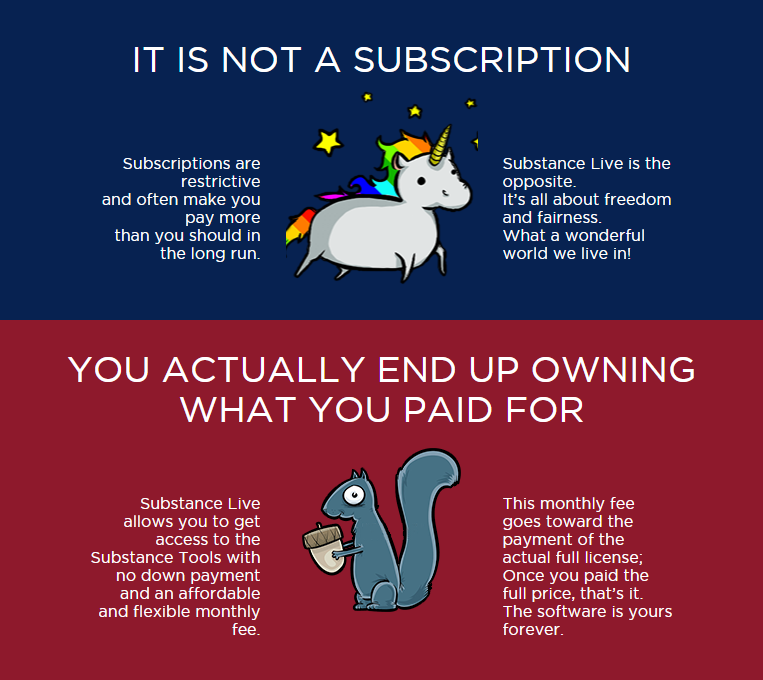
Depending on your yearly revenue, you would pay a total cost of either $320 or $1,040, after which you would own your license forever. Or you could stop paying any time, and if you didn’t own the full license yet you would lose access until you resumed payments.
This was a gorgeous, business-savvy, user-respecting model that was rare to see in the digital art space, due to Adobe’s predatory presence. Everything was rainbows and unicorns… until Allegorithmic took the golden parachute and sold themselves to Adobe, and all of this quickly disappeared.
Service fragility
The first way the service-ification of tech starts to show its rot is that services are fragile. Anything from a cyber attack to a policy change to a bankruptcy can take the service down. This is a fundamental trade-off of using services rather than your own tools: services can be more useful in some cases, but the loss of control introduces risk even in cases when both sides are acting in good faith.
If I own my own tools, things only go wrong when I screw up. If I’m using some company’s tools at their pleasure, things go wrong if something happens on their end, and they still go wrong if I screw up. The risk of catastrophe goes up when you add more points of failure, not down.
This is one of the fundamental reasons to use non-proprietary tech when possible: you want it to keep working, no matter what happens with somebody else’s servers. Proprietary tech invites threats into your life, so open software is a win just for being one less thing that can cripple you.
SLAs and Responsibility
The fragility of subscription tech is exacerbated by the absence of service-level agreements in the consumer space. When a company makes an agreement to purchase a service from another company both parties sign an SLA, which obligates the buyer to pay and obligates the seller to actually deliver the service to satisfaction. These SLA agreements usually include at least a standard and a lifespan, i.e. “we will maintain at least X level of service for 10 years”. This is what you would typically expect from a mutually beneficial economic transaction — in stark contrast with the predator/victim relationship corporations actually have with their consumers now.
If the seller fails to deliver as agreed they are not only in breach of contract, but they are typically responsible to provide restitution for any issues their outage caused. This is called indemnification: if someone’s violation of the SLA causes the other party damage, they have to make restitution for those damages.4 When working with other companies, vendors are responsible for any mess they make.
But not so with you and me. When telecom companies work with each other, if one doesn’t deliver the promised internet speed to the other, it’s an emergency. But when providers short consumers it’s just free money for them. There’s no recourse for harm caused or damage done when it’s against consumers, so companies do them freely whenever it profits them.
In practice, an SLA is the difference between your service building the necessary infrastructure to actually deliver what you paid for, and them building the leanest thing possible, pocketing that money and shrugging and saying “what do you expect us to do about it?” when their garbage predictably fails.
People often feel there is an implicit agreement when they buy a smart product for the company to support it for a “reasonable” amount of time, but this is only really based on what people reckon should be the case: in law, no such implicit agreement exists. Without an SLA you’re not buying from a supplier, you’re a raccoon digging through dumpsters for whatever scraps you find. Legally, companies are free to change their policies and discontinue these consumer services at their leisure without bearing any of the responsibility, leaving people with bricked hardware and a life that depends on something that suddenly no longer exists.
Fragility: Google OnHub and Revolv
Google’s $200 OnHub router, launched in 2015, was configured through their fancy OnHub app. Instead of the usual router architecture where you configured your own router by connecting to it, OnHub required configuration to be done through a Google cloud service. This meant you could configure it remotely, but also meant it depended on those servers, so you depended on Google not taking them down.
This is an important fragility rule: if a product is built so that it needs to go through the internet to work without a local-only option, that’s a trap. 100% of the time, the company will use that to harm users, either by exploiting them or just killing the product.
In 2022, Google did just that, destroying the value every OnHub router owner thought they’d purchased. And all Google did in return was offer to give OnHub owners a discount if they wanted to buy more Google hardware to replace it.
For Ars, Andrew Cunningham wrote That Google can take an aging but perfectly functional router and switch off big parts of its functionality is one of the downsides of networking hardware that requires you to sign up for an account or use an app to administer it.
Mesh systems like Google-owned Nest and Amazon-owned Eero offer simple configuration, affordable pricing, and an overall ease of use that these more advanced products can’t always match, but the downside is that your router’s manufacturer might decide that it’s time for you to get a new router whether you’re having problems with the old one or not.
This isn’t the first time this happened. Like, exactly this: Google, killing home routers, using subscriptions, in the conservatory. I give you Alex Hern, “Revolv devices bricked as Google’s Nest shuts down smart home company” (2016).
Before being acquired by Google, Revolv was competing with Google’s “Nest” system, which Google had acquired from yet another company they purchased. Good news for Google’s product catalog: when Google bought Revolv, Google took the best of the Revolv technology and integrated it to the Nest product line. Bad news for customers: only two years later, Google announced that they were reaching into all former Revolv customers’ homes and killing everyone’s Revolv products. Not just shutting down the service, actually disabling the hardware in people’s homes that they paid for.
Homes that didn’t throw out their perfectly good Revolv tech and upgrade all their hardware when Google gave the command quite literally went dark. And, of course, the DMCA makes attempts at repair or replacement felonies. Products still under warranty? I guess they’re just not, anymore. That’s a thing they can do, apparently. I guess “theft by manufacturer” isn’t legally considered a defect, per se. But it really needs to be.
Fragility: Toyota Safety Connect 3G
Remember the Toyota Remote Connect subscription I defended before? Here’s another story. In 2022, the old 3G cellular network was finally retired. It was taking up valuable spectrum and had long-since been replaced by 4G and LTE networks. But Toyota’s predecessor service offering to Remote Connect, “Safety Connect”, ran on the 3G network. The service itself was network-agnostic of course, but the cars themselves (models as recent as 2017!) were only outfitted with 3G hardware and without any modern wireless hardware, they were left stranded when the 3G network went down.
Toyota could have offered to retrofit those now-broken models with wireless hardware that wasn’t ancient, but they chose to just not do that and instead let the customers suffer the damage of their negligence. Features that were major selling points on those vehicles were gone overnight, and Toyota refused to offer any option to retrofit the vehicles with new hardware, conveniently leaving customers with no option but to purchase a new car.
Fragility: Atlassian
Atlassian is the vendor that sells Jira5 and BitBucket, major enterprise project and code management tools. In 2020, Atlassian announced the next step in our incredible journey: forcing people to stop running their own servers and pay Atlassian for a cloud subscription:
Scott Farquhar, “Accelerating our journey to the cloud, together” On February 2, 2021 Pacific Time (PT), the following changes will go into effect:
End of new server license sales: You can no longer purchase or request a quote for a new server product. Updates to server prices: We will implement new prices for server renewals and upgrades. On February 2, 2024 PT, the following change will go into effect:
End support for all server products: This means that support and bug fixes will no longer be available for your server products.
So now not only are people forced onto a subscription service they don’t want, but they also can’t host their own services, and are completely dependent on Atlassian’s cloud service! But wait, doesn’t Atlassian have a reputation for terrible cloud reliability? I wonder what the next thing will be to happen.
Tue Apr 12 16:12:50 +0000 2022Update on cloud outage impacting ~400 customers. As part of scheduled maintenance our team ran a script to delete legacy data from a deprecated service. Instead of deleting the data the script erroneously deleted sites, and connected products, users, and 3rd party apps. (1/5)

That’s right, it’s a forced-move service-fragility molotov cocktail. Atlassian’s cloud service — which they decided was the thing to offer, instead of “software you can run” — went down in April. And things were bad. After a full week of no service Atlassian still didn’t know when things would be back.
Finally, several weeks after the outages Atlassian released its writeup, and it is a doozy. It wasn’t an attack, it was their own gross incompetence. In their own report, they explain that while deleting records of an old application — as part of moving more functionality to the cloud, in fact — they ran some untested script they wrote in-house with no checking and insufficient documentation, such that instead of deleting an application by ID, it deleted entire sites by ID. That’s right, Atlassian just deleted the data themselves, resulting in “an immediate deletion of 883 sites (representing 775 customers)”
Atlassian’s customers bought into their software ecosystem back when they could control their deployment of their software. Then they switched to Atlassian’s cloud model because they were locked in and forced to.
The problem isn’t even what a dumb mistake that was, or that it’s somehow unforgivable. The problem is that never should have been their mistake to make in the first place. They never needed to endanger their customers by making themselves responsible for their data!
The cloud is just somebody else’s computer. Including extra parties as single-points-of-failure replaces a situation where if you make a mistake you lose everything, with one where if either of you make a mistake you lose everything.
Cloud solutions like Atlassian’s might be better than self-hosted software occasionally, but that does not give vendors carte blanche to kill off their old software products to force people onto service contracts — especially when those services are more fragile and introduce avoidable danger!
Fragility is usually unnecessary!
This problem — that applications depend on some infrastructure controlled by the manufacturer — is an entirely solvable one. There is no technical limitation that means the vendor must maintain absolute control over the product. That’s a lie, propagated by the vendor because of how it obviously benefits them for people to think that.
To illustrate, let me just quote directly from Phil Windley, “Alternatives to the CompuServe of Things” and Phil Windley, “The Self-Sovereign Internet of Things” (with minor edits):
Phil Windley, “Alternatives to the CompuServe of Things” The current architecture for IoT ensures that people are merely renting connected things, not owning them, despite paying hundreds, even thousands, of dollars upfront. Terms and conditions on accounts usually allow the manufacturer to close your account for any reason and without recourse. Since many products cannot function without their associated cloud service, this renders the device inoperable.
Phil Windley, “The Self-Sovereign Internet of Things” I’ve been contemplating a self-sovereign internet of things (SSIoT) for over a decade. An SSIoT is the only architecture which frees us from what I’ve called the CompuServe of Things. Unlike the CompuServe of Things, the SSIoT1 supports rich, peer-to-peer relationships between people, things, and their manufacturers.
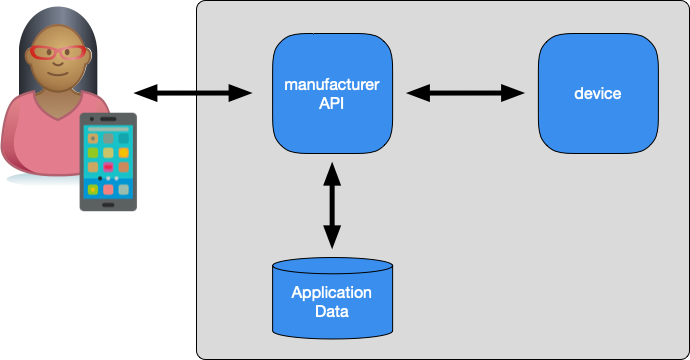
In the CompuServe of Things, Alice’s relationships with her things are intermediated by the company she bought them from.
In this diagram, Alice uses Baratza’s app on her mobile device to connect with Baratza’s IoT cloud. She registers her coffee grinder, which only knows how to talk to Baratza’s proprietary service API. Baratza intermediates all of Alice’s interactions with her coffee grinder. If Baratza is offline, decides to stop supporting her grinder, goes out of business, or otherwise shuts down the service, Alice’s coffee grinder becomes less useful and maybe stops working all together.
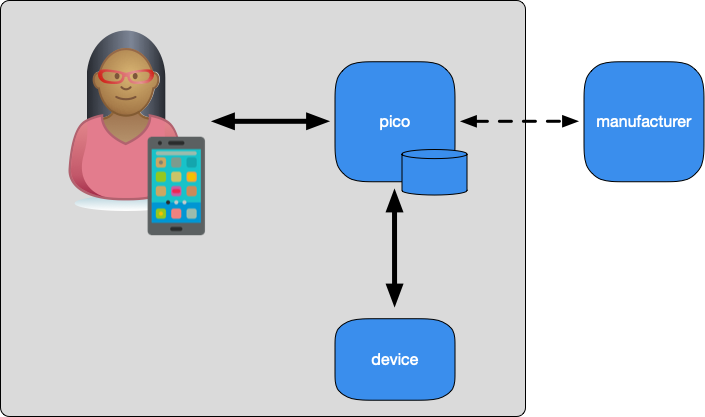
SSIoT: In this diagram, the coffee grinder is a fully capable participant in Alice’s relationship network. Alice has a DID-based relationship with the coffee grinder. She also has a relationship with the company who makes it, Baratza, as does the coffee grinder. Those last two are optional, but useful—and, importantly, fully under Alice’s control.
Devices don’t need to be fragile. They’re fragile as a convenience to the vendor and as a way to exploit non-expert consumers for profit.
Worse than fragility: threat
So far I’ve been exemplifying fragility in terms of accidents and relatively indirect hostility. But relying on third parties doesn’t just add them as a possible point of failure, it adds them as a potential threat. (And not just because everything in your life you don’t own makes you dependent, as opposed to self-sufficient, which is a threat in and of itself.) Using networked services generally introduces a huge number of threat vectors from both traditional attackers (hackers, ISPs, hostile government) but also from the corporation you’re directly interfacing with.
If companies have data of yours they don’t need, they can and will misuse it no matter what promises they make. Making sure you depend as little as possible on networks and servers and wires you don’t own is a basic, necessary step to mitigate those risks. There is genuinely an embarrassment of evidence for this — enough for a person to spend the rest of their life reading case studies and falling ever further into despair — but I’ll just pick out an example from the very recent past: the Eufy camera story.
Anker — a major Chinese electronics manufacturer — sells a line of smart home products under the “Eufy” brand name. This includes smart locks, auto-vacs, alarm systems, and a whole range of connected cameras from security systems to baby monitors. And those cameras turned out all-the-way bad. Not long ago I was considering getting their cameras for my own security system, actually, but I ended up deciding against it, and it’s a good thing I did.
Eufy makes privacy a major selling point for their cameras. The tagline on their site right now is “What happens in your home stays in your home”, and they make clear promises that footage from your cameras “never leaves the safety of your home” except when it’s streamed “straight to your phone”, end-to-end encrypted. Those should be reassuring promises, as it means someone intercepting the feed — or Eufy themselves! — doesn’t have a raw video feed to surveil your home. Safe! Private! Good! The only problem is it was a complete lie.
After a little analysis, security researchers found that Eufy’s supposedly cloud-free cameras were streaming massive amounts of data through Eufy’s cloud servers. Not only did the cameras run facial recognition on their feeds and push thumbnails of people directly to Eufy, the entire high-quality real-time video feed was being sent through Eufy’s servers, where it could monitor, record, or even tamper with any footage collected by any of its widely-popular cameras. This was confirmed outright due to Eufy’s abysmal security: not only did the video go in, you could actually stream video out from Eufy’s servers with no encryption whatsoever, using normal consumer software, if you just knew the plain-text id of the camera.
A Eufy senior PR manager lied to The Verge that “it is not possible” to watch footage using a third-party tool like VLC, despite people demonstrating using VLC to do exactly that. PR people lying to protect their companies aren’t making mistakes, they’re lying. And the response they gave to being proven liars really was to just lie even more about it. Which, instead of going to jail, they were paid for! “Lie when you get caught” is a real job they performed correctly, somehow! That’s who you’re trusting your infants to!
Eufy’s entire business model depended on promises they made about how their service worked. But they sold cameras that used proprietary Eufy-brand software and standards that people aren’t even legally allowed to directly introspect, which let them just demand that people trust them. And many people did trust those promises, but to their own destruction.
Eufy is still fraudulently selling cameras with these promises today. It’s overt, flagrant fraud, but it’s what we routinely see under the skin any time any of these companies that have made themselves responsible for processing large volumes of people’s valuable personal data get even the lightest scratch.
Meanwhile, because the service the business was built on was a lie, it turns out that literally every Eufy customer paid full price for a product and service they never got, and the company never planned on delivering. Every single incoming sales dollar the company ever got should be owed back to their defrauded customers. I’ll give you three guesses as to whether that’s actually going to happen.
Illegitimate encroachment
Incredibly, even Eufy’s pricing model fits under my incredibly broad definition of a “legitimate” subscription, because they actually did pay to run a service that provided some amount of value to people. The nature of the service was fraudulent, but at least the pricing model was legitimate. But it gets so much worse: far too often, companies just invent ways to charge people rent by funnelling them through services where the expense has no relationship with the cost.
Mon Feb 20 02:58:32 +0000 2023It's too hard to start a business that provides a useful product or service, I want to do the kind where you trick people into giving you money

Subscription software
In these cases of utterly illegitimate, fabricated pseudo-service subscriptions, companies demand you pay them an ongoing fee for something they have no right to charge for, like the privilege of running software you purchased on your own device.
Because, by the way,
Normal software is property. Yes, really.
Some self-indulgence here, briefly.
Normal software — Microsoft Office, Steam games, phone apps and the like — are goods that the buyer owns. Buyer/owners retain full property rights over them, although — as in the case of resale — they are routinely denied these rights.
When you buy software, you buy a “perpetual software license”, which grants you the same “license” or permission to use the good that you have for physical goods. Perpetual licenses act like scarce goods and transfer rights of ownership away from the former owners when sold. This includes the original developer, who after selling a copy of their software must not retain any decision-making authority over the use of that particular instance/good. This decision-making authority is a key part of the right of ownership, and it’s one that’s routinely violated in the instance of software. But it is a serious violation, no matter how regular it has become.
First-sale doctrine means the seller exhausts their rights over goods when they’re sold. After you sell something, the other person owns it, not you. This has been clearly established in EU law, where their courts clearly found that “the copyright holder transfers the right of ownership of the copy of the computer program to his customer”. We see the same in Canada and Australia. WIPO, the World Intellectual Property Organization, is the governing body that manages the International Classification of Goods and Services. That trademark classification — part of a giant multinational trade treaty — explicitly classifies software (including games) as (class 9) goods rather than services.
The US Supreme Court has never squarely ruled on this issue. The US itself classifies software as a good rather than a service, and the USA is a signatory on the WIPO treaty. But lower court rulings have been bizarre and inconsistent. However, it has been clearly established under the first-sale doctrine that customers retain the right to resell their goods without the permission of the manufacturer, even if those goods include copyrighted material. In fact in this case the judge singled out the case of software (using cars as an example) as an instance where the first-sale doctrine does apply. Yes, this also applies to patents.
So yes, you own software you purchase. It’s not a rental, it’s not used at the pleasure of the company, it’s your property and if anyone says otherwise — or if a company tries to take control of software you own — it’s your duty to slap them for it.
Software-as-a-Service
Traditional software is a tool you can use. If you possess the tool, you can use it to create value. You can tell it’s a tool and not a service very easily by noting that it doesn’t provide the value unless you do all of the work. You have to provide the hardware, you have to pay for the power, and you have to sit down and use the tool for it to work. There’s no external service coming in and making it happen for you. Even if you’re using a tool you bought from someone else, it’s clearly your resources and your labor that enable whatever value it generates.
Software as a service, then, is software that you have to rent, not buy. It’s usually not actually provided to people, but instead run on a cloud server which runs the service and just doles out the results. Most “web apps” fall into this category. Software can, of course, provide a legitimate, valuable service. Google Docs’ real-time collaboration tools are genuinely valuable and something you can’t get without the “service” part. And remote file hosting is an extremely useful ability to have, but it has a high set-up cost, and both storage and bandwidth cost money on an ongoing basis. I’m more than happy to pay an ongoing subscription fee to have that service, because there’s an ongoing cost.
But more often than not “software as a service” is companies illegitimately converting software without an ongoing cost to subscription models as an attempt to create an ongoing need they can charge rent for. Companies can keep people dependent on them and stranded without them by just… not letting them run the software themselves. They just have to keep the server hosting software to themselves, and, through a combination of technical legal chicanery, it’s a felony to try to make your own replacement, even if the company stops providing the service.
The push to force subscription services has been extreme, with Adobe as one of the worst offenders. Adobe was one of the first (killing off Creative Suite entirely in 2013 shortly after launching Creative Cloud and later barring owners from installing CS even if they owned licenses and the original installation media), but lately other serviceless companies have started frankensteining their products into subscriptions for goods charged as if they were services. VMware is an example of this, deciding in 2022 on “restructuring the contracts from perpetual to subscription”, a decision that inflates the price of software that’s already considered overpriced, and seems to be mostly designed to exploit people who are already locked-in to the VMware ecosystem.
The technique of taking local goods and charging rent for them has been much more profitable in the digital space because the regulability of software gives companies the leverage to do it without outrageous overhead costs. In the real world, the cost of running a subscription business scales with the number of customers. Physical objects cost money to ship. If you’re renting cars, you have to physically store cars, manage customers’ identities, and be prepared to repossess the vehicle if they stop payment. Hell, even landlords have to actually own property proportional to the number of tenants. Real capital wears out and requires maintenance, replacement. In real life, people sell things because renting is work.
But in software, all of that is free. Tech lets companies reap the profits of renting without the usual overhead. Vendors only need to distribute the software once and then their software can police itself for them. There’s a minimal cost to maintain a license server, and no processing cost if the software runs on the user’s PC. There are none of the usual cost tradeoffs companies make for reserving property rights themselves instead of allowing customers to make real purchases. Instead it’s just free money, since DRM lets companies offload all the actual work of enforcement to the customers’ machines. The user and all their resources are conscripted into being someone else’s repo man.
Trying to rug-pull sales
But people do not want that. So, for businesses to force people to start buying a worse product instead of actually producing value, they have to cheat.
Because late capitalism is inevitably more cartoonishly awful than any parody, most of them decided to force people into subscriptions by destroying the products they already owned and paid for. If you’re willing to violate your customers to make cash and you’ve already used all your fraudulent warranty stickers and written “only use our brand of refills or you might die” everywhere you can, you just steal from your customers outright.
Companies are in a constant, ongoing process of making decisions in pursuit of immediate profit. This isn’t always bad, but it’s why it’s vitally important to make sure they don’t have the ability to break things. The incentive is well-understood and the structural solution is easy: make sure companies can’t kill your property after they’ve sold it to you.
And no, it’s not enough for it to be theoretically “irrational” for a company to piss off their customers. The evidence shows corporations will stab you in the back anyway. The incentive is too great and the gamble that they’ll never be caught and held accountable looks like a good one. It is, evidently, just too tempting.
Replying to merzb0w:Tue Dec 14 23:38:01 +0000 2021Bigger overpriced but inferior companies buying up all of the independent intuitive companies end up killing the software & making it multitudes more expensive.. just look at Adobe acquiring allegorithmic. They promised itd be fine & now you can't even BUY the software

Replying to merzb0w:Tue Dec 14 23:46:42 +0000 2021The language they use about whether or not my perpetual license will continue has me like 🧐🧐🤔🤔🤔

Nvidia GameStream
The Nvidia Shield is a ~$200 android-powered home media center and gaming device. Its flagship feature since launch has been Nvidia GameStream, which lets you stream video games to your TV from another PC in your home like Steam remote play does.
This wasn’t a “cloud gaming” system. In fact it wasn’t a service at all; GameStream used a local protocol that ran between your PC and your Shield without going through any Nvidia infrastructure at all. (You can emulate it yourself without Nvidia using Moonlight if you want.) And this was intentional: going through cloud services adds stops and increases latency, but using a local system prevents that and lets you stream your games to your TV — at up to 4K at 60fps! — effectively.
As of late 2022 though, Nvidia decided to take that away. Nvidia announced that not only is it going to stop manufacturing Shield devices with GameStream support, it’s actually going to actively remove it from devices it already sold with the feature as a main selling point. If you refuse the “update” you can keep using the feature temporarily, but you’ll eventually lose compatibility with everything else.
Nvidia offers one alternative solution for game streaming they’d like people to move to: GeForce Now, its premium subscription cloud service. For $20 a month you can stream a limited subset of the games you own over the internet from an Nvidia cloud machine, with better graphics hardware but much worse everything else.
clip, 11:45-14:00
So if you want to play one of the games they already have installed on one of their computers, and you can persuade them that you own the game, and you have a world-class high speed internet connection, and you’re okay with increased latency, you can pay Nvidia $240 smackeroos a year — more than the full price of buying a Shield outright — to do what you were doing freely before, but in many regards much worse. It’s not even close to comparable with the GameStream feature they’re killing: you’re better off ditching Nvidia entirely and just installing Steam Link on better hardware.
Nintendo emulation
The property rug-pull is the very foundation of Nintendo’s retro gaming business. In the past Nintendo has sold copies of its retro games in a number of forms: mostly downloadable, like the Wii Virtual Console for ~$10/game and the 3DS Virtual Console for ~$8/game, but some physical, like the NES and SNES classic “consoles”, which came with ~20 baked-in games for $60 and $80, respectively.
All these are tied to Nintendo hardware; they don’t let you extend the collection on the Classic consoles, and they certainly don’t sell portable versions of these games you can play on your PC.
In all cases, Nintendo’s resold retro games use a form of emulation. Nintendo used the exact game files from the original releases of the games6 but replaced the original console hardware with software that ran the files the same way the original consoles did.
Despite the fact that the games are the same, none of them are interoperable. If you want to keep playing a retro game, you have to hope Nintendo releases a new emulator each new system, so you “get” to buy it again.
Nintendo didn’t pioneer emulation, it copied it. For decades, fans have been making digital copies of their cartridge games and writing emulation software that lets them play those games on other systems.
Nintendo despises this because in addition to its obvious legal uses, emulators can also be used as part of game piracy. And so Nintendo has waged a scorched-earth campaign on the communities involved to a truly ludicrous extent, including exhaustive lobbying in Japan to use government force against emulation and in the US, targeting a Switch hacker and getting the DOJ to intentionally make him an “example” and leave him “socially isolated and financially destitute.”.
But this piracy problem is entirely invented by Nintendo, a company that insists on selling people games they already own. This is something I’ve discussed before in Nintendo: It’s about control, not piracy. If the question of whether or not each running copy of the game maps to a real purchase isn’t even part of the discussion, it’s not about piracy, it’s just about control. Nintendo doesn’t care about people who bought and own games being able to play them, which should be the main thing a company that sells games cares about.
Thu Nov 19 22:19:32 +0000 2020To be perfectly clear, this is Nintendo threatening people with legal action for... playing old games. Not piracy, not TOS violations, just the idea of fans having the option not to continuously pay for new games. twitter.com/SSBUNews/statu…

Replying to giovan_h:Thu Nov 19 23:16:13 +0000 2020I own a physical copy of melee on an original gamecube disc printed by Nintendo. They don't care. That's not what it's about for them. Piracy is an interesting topic but in this case it's clearly just a distraction (or, in some circles, a convenient legal justification)
Which finally brings me around to Nintendo’s current model for printing money: selling Netflix-style subscriptions to their back catalogue of games as part of Nintendo Switch Online. Out of context, this seems fine: I pay for Online anyway, and getting access to a back catalogue of games seems like an obvious win. There are two problems. The first problem is Nintendo’s software isn’t as good as the community’s, but that pales in comparison to the oft-missed fact that this entire setup is highway robbery.
Nintendo wants to force people into a subscription service to play retro games, no matter how many copies their customers already bought and already own. It doesn’t matter if you bought the game already for Wii, and then bought the game again for the 3DS. Even if you bought an original cartridge, Nintendo not only doesn’t let you run the software you own on your Switch, it actively campaigns to make the tools to play those games — games that it no longer sells the hardware to play — FBI-open-up bust-down-your-door illegal.
Nintendo can only sit back and collect an extra 150% for its remarkably poor Nintendo 64 emulator because instead of “making and selling video games”, it’s convinced the cops that people who play games they own without coughing up more cash should be made an example of and left socially and financially destitute.
Wizards of the Coast
Companies do this rug-pull all the time, even outside the digital space. Think about it: if you could sell things for profit and then un-sell those things for free, why wouldn’t you? Human decency perhaps, but companies don’t have that — they’re profit optimizing machines.
Hasbro subsidiary Wizards of the Coast published the Dungeons and Dragons Open Gaming License 1.0 in 2000, which granted “perpetual, worldwide, non-exclusive license” to the core rules, allowing third-party publishers to “copy, modify and distribute any Open Game Content originally distributed under any version of this License” in order to write stories, expansions, and rulesets compatible with the main game.
While that permission was arguably unnecessary or even harmful (since WOTC was granting rights to use game mechanics — which are famously not copyrightable intellectual property in the first place — the OGL gives you permission to use things you shouldn’t need permission to use), this encouraged publishers to write and sell content, and created a vibrant community of writers and players. Businesses could safely build on the rules as bedrock, because they had explicit confirmation that that bedrock was not, and could never become, proprietary.
But WOTC attempted to publish a revised version of the OGL, OGL 1.1, which attempts to pull the rug out from all of that. Wizards have decided, retroactively, that the OGL was “always intended to allow the community to help grow D&D and expand it creatively” but “wasn’t intended to subsidize major competitors”. This is a lie, of course — the OGL 1.0 was always specifically designed to let people create and operate businesses creating works for D&D.
Wizards’ legal argument — that they have the power to deem the 1.0 “unauthorized” — is tenuous at best and blatantly illegal at worst, but more importantly it’s a classic attempt to seize the commons. Wizards created a common environment and encouraged people to contribute to grow the value of the franchise. This was a massive success: at the cost of some power, they’ve developed a popular and successful product. But now that they have that, they’re trying to seize that entire common space, revoke the irrevocable permission it was built on, and take the entire industry for themselves.
Soft rug-pull: updates
Earlier, I talked about how sales is inherently a kind of speculation. When a customer buys a digital product (a lifetime license) they’re hoping that company stays in business. Hopefully they’ll release useful updates and let people get more value out of the purchase, but at a minimum the company needs to be around to provide downloads and release security fixes as needed. That means — since you’re not paying on an ongoing basis — you’re hoping the company continues to make sales, as that indirectly benefits you.
In the world of software with a subscription option, choosing to buy a “lifetime copy” means you have to pay more up front, but you’ve also pre-ordered any future updates down the road in advance. So buying a permanent license means if the vendor is successful, one gets a return on investment that people down the line might not be able to get. It’s an early-bird reward, where in exchange for paying significantly extra, the customers who took that risk have a great deal locked in.
But, given that this is the deal, companies can’t turn around and then say “we’re successful now and don’t need you anymore, so instead of giving you your returns we’re cutting you out”. It’s true that the past sale of a license isn’t directly making the vendor a profit today, but that’s not an error, that’s the direct previously-agreed-on consequence; the company’s already collected and enjoyed the windfall for that transaction. People paid for their products with a specific expectation of what would happen if the company is successful, and the company is now refusing to pay what’s owed.
It’s defaulting on an obligation at best, but it’s really more like wilful and malicious destruction of property, as the company is destroying property specifically in order to profit off the harmful consequences. This should go without saying, but we don’t need to subsidize corporations’ labor now if they’re speculatively investing that labor making a product that they then sell at a profit. They have no right to get you coming and going.
And they always pretend like what they’re doing is normal and acceptable. When confronted, companies usually insult and belittle people by refusing to engage, acting like the customer somehow made a mistake by trusting them, and ultimately stonewall individuals instead of operating with any kind of good faith. But good faith was never really on the table.
Companies shield themselves with forced arbitration, EULAs and jurisdictions — lots of software companies are strategically headquartered internationally to shield them from responsibility. It’s only ever consumers who are stuck with the damages and have no choice but to buy repairs from their very assailants.
Clip Studio Paint, “2”
Remember Clip Studio Paint and its excellent one-time purchase model? Well, for 2.0, Clip Studio Paint announced on Twitter that after version 2.0 not only will it no longer be selling perpetual licenses, it will also refuse to honor the perpetual licenses people already bought. It also refused refunds7 to perpetual license holders, whose license CSP is now violating themselves.
Originally CSP was in the business of selling licenses, but if you really needed a “flexible plan” there was an option squirreled away in the corner. But then they decided they would prefer people to use the subscription model.
Yes, that’s fraud. Yes, even according to their own fine print. The “Product” being sold is “Clip Studio Paint and Clip Studio, including all accompanying electronic data… and the latest version of the software, including updates, bug fixes, and corrections.”
Now that Clip Studio Paint is a competitive industry standard — a position they were only able to acquire by being consumer-friendly and selling perpetual licenses — they’re trying to exploit that position and go back on the very guarantee that got them what credibility they have. Revoke all the rights you sold in the first place, but keep all the profit.
Wondershare Filmora
Wondershare pulled this exact same “you paid up front for updates? how about you pay us now anyway” stunt with their popular video editing suite Filmora.
Today, Wondershare offers three plans for using Filmora: $69.99/yr to use Filmora 12 only on Windows, $89.99/yr to use Filmora 12 on Windows, Mac, iOS, or Android, or $109.99 for a “Filmora 12 perpetual license”. The perpetual license lets you buy Filmora 12 and install it and use it without them coming in and pulling the plug on you every year. If you want to keep using the current supported version of Filmora though, you’ll still have to purchase another perpetual license when they release the next major version, which they’ve been doing about once a year anyway.
If you look at that main Filmora purchase page, a bizarre amount of time seems to be spent nitpicking the details of how upgrades work, and what all they’re not planning on giving people. The first FAQ qualifies that “A perpetual Filmora license allows you to use a specific version of Filmora continually with payment of a single fee”, but not future major versions. The next FAQ, “What is the difference between update and upgrade?” defines “upgrades” as major version bumps, and “updates” as other minor updates.
All that conspicuous extra attention is because — as of version 12 — Wondershare is trying to pull a fast one. Just a few years ago, Filmora’s pricing options were $39.99/year or — the option they labelled with an eye-catching “best seller” banner — a $59.99 permanent license for the software. And this wasn’t just a license for Filmora 8, it was very explicitly labelled “Purchase this license for Personal use and enjoy free lifetime updates” and “All software updates are completely free.” Eventually in 2020 they stopped offering actual licenses and replaced this with the “perpetual” single-version option, which is a shame but not unreasonable.
But now, in 202X, some executive at Wondershare realized people who bought the right to use and update the software years ago weren’t actively shovelling him their money, so Wondershare just violated all their own licenses and “cancelled” all the Lifetime Licenses, something they had no right to do.
This was reported on at length by ex-Wondershare/Filmora brand ambassador Daniel Batal in a truly infuriating story. First, Wondershare just pretended they weren’t making any changes at all, and that the licenseholders who wanted to keep using their product were the ones suddenly causing a problem. The word is overused now, but it really was gaslighting: Daniel recounted
One of my fellow creators who I know really well and who also has a lifetime license had shared with me a screen capture of a conversation he’d had with Filmora where they kept referencing Perpetual plans, no matter how many times he told them “but I have a lifetime license not a Perpetual plan.” It’s like they weren’t hearing them.
This isn’t an accident, and you see it all the time — companies pretending not to know about and refusing to acknowledge their own obligations. In this case, they were pretending a product they sold — that they knew full well they had sold — never existed!
This also wasn’t a new concern. Perpetual licenses were introduced with version 10, not version 12, and Filmora had always been acutely aware of the difference between those and the licenses they had sold previously:
One of the biggest questions I got from a lot of people when we first saw these Perpetual plans take the place of our lifetime licenses was “were our lifetime licenses now somehow in Jeopardy?” But thankfully the filmora team explained to me and all the other users out there even though they no longer offered that particular license, we were still all allowed to update-I-mean-upgrade to the newer versions, and we all did. For me that license allowed me to update all the way from Filmora 8 through Filmora 11.
What Daniel had been glad to see in the past with perpetual licenses — and what was suddenly absent with version 12 — is just a bare-minimum factual awareness of reality. Discontinuing the sale of a license doesn’t magically revoke it! It’s still a real and binding thing you sold people! For money! Which Wondershare has already spent!
In fact, Wondershare themselves very clearly wrote on the Filmora 12 upgrade page that lifetime users would get a free upgrade to Filmora 12, but then rolled it back and lied about it! It wasn’t an accident, it wasn’t unclear communication, it was a clear and intentional robbery they chose to commit as a dirty little cash grab.
Hardware ransoming
But it gets worse. Of course it gets worse, it always gets worse, we live in an actual nightmare. It’s bad enough that companies are able to get away with this in the digital world, but there’s a push to bring this perpetual service-model payment to the material world and simple gadgets where there’s no ongoing cost and no expectation of any ongoing support or updates, where a perpetual fee is just utterly unjustifiable.
The model is this: the company manufactures a tool (hardware), they sell it to you and you pay for it outright, but then they demand that you continually pay them whatever ransom they please or they’ll kill it remotely. Instead of paying to have something new added, or paying for a service to be provided, you’re paying to stop a company from actively withholding your own property from you. You pay indefinitely for the privilege of using hardware you purchased at full price. At least, until they decide they want you to buy the new model, at which point they can “revoke your right” to use your own property.
In practice this is usually done by selling intentionally defective hardware. Batteries that won’t charge, engines that won’t run, heating coils that won’t work. They intentionally sell things that don’t work, by design, so you can pay them whatever price they demand to temporarily let you use your things.
And, because denying you use of your tools makes them money, doing the work to make them work yourself is felony contempt of business model: Under US law (the DMCA anticircumvention clause) it’s illegal to use your own things if an executive at a company decided they wanted you to have to pay them to, and you aren’t.
This “ransoming” of hardware is some of the worst behavior in the industry, but it’s only becoming more and more prevalent. It’s most common in cars and printers, but it’s spreading through tech and to tech-adjacent industries like a cancer.
Being able to “instantly upgrade” hardware is billed as a convenience to the user. “The hardware for this feature has already been installed in your vehicle during production, at no extra cost.” At the same time it lets companies streamline the supply chain by reducing the amount of hardware sent out by the company and then only manufacturing and distributing a single hardware variant.
It makes sense on paper, except if you pull your head out of the paper and subsequently out of your ass it’s very obviously bullshit. It’s not an “upgrade” to the customer to “unlock” features; the payment in no way creates any value, it’s just what the company demands to stop actively destroying value we already own. When you pay a subscription fee for a car feature, you’re not having some new functionality beamed to you, you’re just being allowed to use hardware you already own. We as customers want real value provided, not value taken from us.
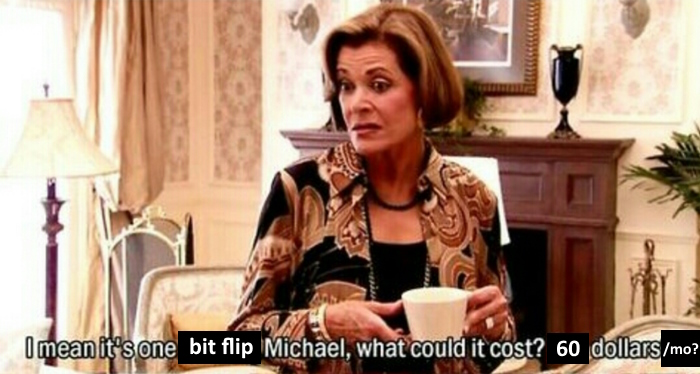
And in the case of hardware, don’t be fooled, they’re not taking a loss on the initial hardware. Every bit of hardware is already factored into the base price, this isn’t the damn cuecat. If you buy a BMW (at 300% MSRP, no less) the dealership isn’t taking a loss when you walk out the door and just hoping you’ll buy some subscriptions. BMW didn’t say “You know what we should use as a loss leader? Cars.” You’re always paying for the cost of the hardware up front too; the subscription is always a double-dip.
The only sector that comes close to “we’re losing money on each sale, we’re cRaZy” is smart TVs. “Smart TVs” have gotten extremely cheap because in addition to forcing unavoidable advertisements into basic system functions (changing channels? wait for the ad roll), they’re sold pre-infected with invasive, unremovable spyware. This provides a huge post-purchase revenue stream to the manufacturer, who get to sell you out to advertisers and data brokers. But these TVs are sold on thin margins, they’re still not sold for less than cost.
This ransoming back of goods you’ve already purchased happens in the digital space because that’s the only space where it’s really technically feasible to remotely exert enough control over people’s property to enforce the arbitrary restrictions required, in a way that scales. Connected digital tech — or tech that can have digital connections grafted onto them, as is the case with cars and shutoff devices — can be controlled remotely by the vendor easily and at scale in a way that wouldn’t otherwise be possible without massive policing costs.
If you buy a tool like a car, computer processor, or even a calculator, you have a right to expect them to perform to their full potential. It’s entirely unreasonable for a company to sell you the hardware and then demand you pay an extra fee for multiplication, for instance.
This is The Numerus Clausus Principle. The seller does not have the right to invent an idiosyncratic property right and then reserve it for themselves. This includes special rights over parts of the property: TI cannot, by fiat, carve out a “multiplication” property right that they can rent back to you because they didn’t actually sell that right along with the device. It’s your property; you have the right to demand it not sabotage itself at the behest of someone who doesn’t own it anymore, because they sold it, to you, in exchange for money.
Cars
Going back to 2010, Tesla sold cars with intentionally disabled battery capacity and required a one-time payment to “unlock” the full battery. This was an automaker installing hardware into a vehicle, selling that vehicle along with that hardware, and then separately selling a software patch that stopped the car from actively disabling that hardware.
So it turns out Teslas — far from being environmentally friendly — are building and shipping enormous capacities of lithium ion battery that they fully expect to go entirely unused. The environmental impacts of manufacturing vast volumes of lithium battery capacity were deemed insignificant, compared to… a marginal amount of potential profit. That alone is jaw-dropping.

They’ve been doing the same thing ever since. Model S vehicles were sold with different battery capacities at different price points, but to simplify manufacturing, Tesla actually only manufactured the largest capacity battery and installed software locks based on how much you were willing to pay. A 40 kWh Tesla was actually just a 60 kWh Tesla programmed not to work at full capacity. “Defective by Design”, so to speak.
While not a subscription, we see the same “hardware ransoming” at work here, where hardware is manufactured and sold (at profit) with the express intent to only provide the customer value if they paid the vendor again — pure profit. The price wasn’t even nominally coupled with the actual cost of the product, it was solely used as a way to extort customers for higher profits.
And, as noted in the linked article, there was at least one instance where Tesla decided to “revoke” a person’s battery capacity in order to try to charge them for it not just the standard twice, but thrice! (But, when you think about it, is it really any surprise that when Tesla is put in charge of writing the software that adjudicates and defines purchases, that software is designed to err in Tesla’s favor?)
Fast-forward to 2021. Tesla’s flagship product is its “Full Self-Driving Beta” subscription package for a fee of $200/month. (It doesn’t work and is incredibly dangerous for both the passengers and any nearby collateral humans who certainly didn’t consent to be victims of a beta test, but that’s another conversation.)
But other manufacturers are also getting in on the action, most notably BMW.
In 2018, BMW announced that it would be charging a yearly subscription fee — $80/year — to use Apple CarPlay, which other cars sold as a standard part of the vehicle. (This fee was later dropped; evidence that customers understanding the scam matters, and pushback can work.)
When asked about the subscription car push, GM VP Alan Wexler said “What are you paying for Netflix or a music app? We took a very comprehensive look at peoples’ willingness to buy…”, clearly demonstrating the core problem with these faux services: it’s not about providing value, it’s not about what the service costs, it really is just about charging people as much as they’re willing to pay. And, when you’re talking about the inside of a car, the manufacturer has their own little monopoly.
And they really went for the whole subscription-car idea, despite massive backlash. Using its 7.0 operating system and “Connected Drive” options, BMW is charging recurring subscription fees for remote start, heated seats, and the heated steering wheel. That’s right, a recurring fee for the privilege of using fuel you purchase to generate heat. And they refuse to offer a simple fob for remote start: why would they, if they can charge $105/year by not competing with themselves and instead only offering the worse product?
But it’s so much worse than just remote start; they charge subscription fees for safety features like Adaptive Cruise Control and the drive recorder, traffic camera, and parking assistant, which just use cameras already built into the vehicle! You’ve bought a car with sophisticated safety cameras built-in, but BMW won’t let you use your own software, and the only software they offer is this hardware ransoming bullshit. The camera apps can’t be purchased outright. Your kid got run over by a crippleware’d BMW? Turns out it was totally preventable; the driver should have paid the ransom so BMW would stop remotely disabling the safety features.
Ransoming “comfort features” (like heat, as if the cold’s never hurt anyone) and safety features (like the drive recorder) might seem fundamentally different, but it turns out they aren’t. They aren’t different to me, because I say they’re just another example of the same behavior that was already a violation in the first place. And they aren’t different to the companies, who will charge for anything they can regardless of the cost in human lives.
I’d call them “microtransactions”, but they’re really not micro. The price tags on all these features are exorbitant; BMW charges $235/yr for camera access, which is three times as much as what I spent on my whole dashcam, real hardware I purchased once. Again, it’s just about charging as much as they can get away with, and if blocking access to safety features makes money but kills kids, the executive board deems those acceptable losses.
Some of these features haven’t rolled out in the US yet, but BMW is absolutely doing this, right now, with basic features like high beams, camera access, and yes, even heated seats. All the hardware is included, but it’s software locked until BMW decides they’re being paid enough to let you use them.
For more on this, I highly recommend Jason Torchinsky, “BMW’s New Feature Subscription Plan Idea Needs To Be Stopped Before It Starts”:
Jason Torchinsky: This is a terrible path to go down for the entire automotive industry, and we, as gearheads and consumers need to send a clear message to BMW.
How do we do that? Easy. If BMW implements this basic-features-as-subscriptions model, no one should buy a new BMW ever again.
We’ve already seen this bullshit with Tesla, always on the bleeding edge of new bullshit, and how they’ve been trying to charge customers twice (or more) to keep the same features a car was purchased with.
But let’s be clear here: this absolutely, unequivocally, is bullshit.
What this really means is that very expensive brand new BMW you just bought will require you to pay a monthly subscription fee for features that you would expect to be part of the car, like adaptive cruise control and heated seats or whatever, and this is a model that only benefits BMW.

And it’s not just Tesla and BMW. It’s never “just” anything. Mercedes is charging $1,200 a year for full use of your motor: if you don’t pay they intentionally cripple the performance of their electric vehicles.
The only thing close to a silver lining is that, in a few cases, the ransomers have only demanded one payment so far. Tesla pulls the same motor stunt with its Model 3 “Acceleration Boost”, which locks software configuration changes that enable full use of the motor behind a currently one-time fee of $2,000.
The KTM 890 Adventure R motorbike — a ~$15,000 USD vehicle — is slated to come with a so-called “demo mode” that lets users “try before they buy” the full suite of features for the first ~1000 miles, and then requires payment. In reality, owners are purchasing an expensive vehicle equipped with sophisticated tech, but it stops working (including basic off-road safety features!) after a short while unless they go back to the dealership and pay more money for a so-called “software update” unlock.
The car industry is so nakedly predatory right now in this regard that there’s at least some nominal legal pushback. New Jersey Assembly No. 4519 would have ban companies from “[necessitating] a subscription service for any motor vehicle feature” that “utilizes components and hardware already installed on the motor vehicle at the time of purchase.” There’s a lot of sensible language in this bill that touches on the goods and services distinctions I’ve been talking about: subscriptions would only be unlawful if the service didn’t require “ongoing expense to the dealer, manufacturer, or any third-party service provider.” In other words, charging for server hosting (phone apps, OnStar, etc) is OK, charging for heated seats isn’t.
But I wouldn’t put my trust in the government making things better any time soon.
And, because all of this is ridiculous manufactured bullshit, people are figuring out how to “pirate” features by fixing their own hardware. Again, you just need to look at the basics to understand this one: goods and services, clients and servers. Enabling hardware you already purchased isn’t somehow stealing a service. If a capability exists on hardware the customer owns, they own it.
“Pirating” heated seats isn’t “stealing” anything from BMW for the same reason the subscription was illegitimate in the first place: you already own the hardware and you’re powering it yourself. In that way, the fact that people can enable these features using hardware they bought and own without costing BMW anything just proves that “not anything” is exactly how much BMW should be able to charge for it, and it would be if not for this absurd corporate hardware ransoming. The hardware is bought and owned, and the manufacturer’s rights to cripple your property should be exhausted. But, to quote the great James Stephanie Sterling, “no amount of money is ever e-fucking-nough for these assholes.“
Printers
And that’s just the automotive industry.
HP in particular is infamously hostile to consumers in this regard, with “printer-as-a-service” schemes. You can barely own HP printers at all anymore; you’re essentially forced to rent them and pay upfront for the hardware to get the chance to do so. Don’t have a subscription to HP’s cloud scanning service? You won’t be using your scanbed then, not even locally. HP has an “instant ink” subscription service that mails you ink cartridges regularly. Subscription ink as a service almost makes sense… except if you end the subscription, HP bricks the ink cartridges you already have, in a little angry tantrum:
Mon Aug 15 06:03:45 +0000 2022“By cancelling, I acknowledge:
HP Instant Ink subscription cartridges will no longer work after my final billing cycle ends, even if they are already installed in my printer.”

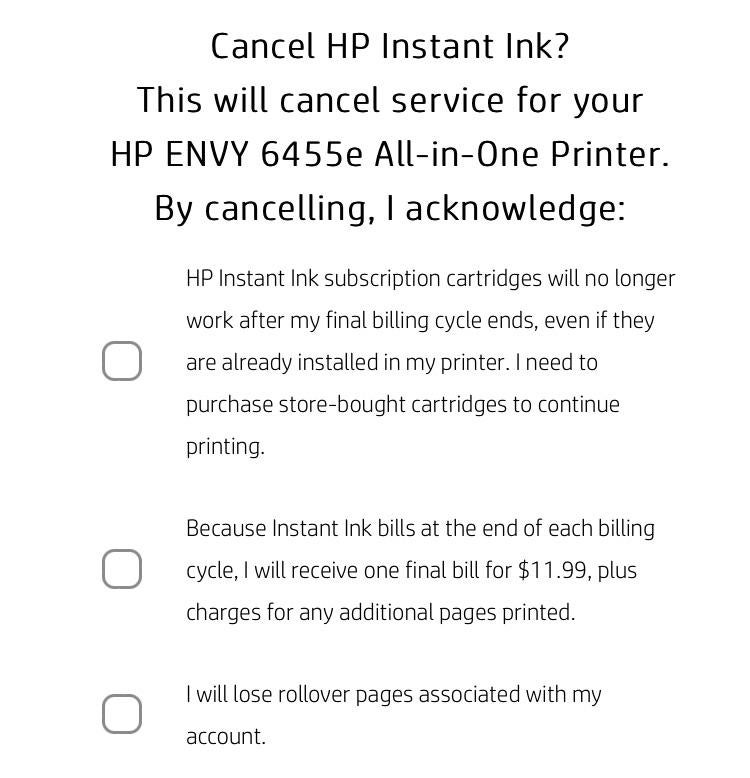
And all these systems fail closed: if there’s a network issue or any ambiguity, HP cuts your service:
Peloton
Another in the category of “luxury” products: the Peloton, or “bad treadmill”.
Peloton Tread owners woke up one morning to find that their treadmills no longer worked. The Peloton Tread has smart features and classes built in accessible with a subscription, but users could always “Just Run” without one. Until Peloton “revoked” the “run on your treadmill” feature, and demanded people pay for a subscription to use their treadmills at all.
Peloton’s justification for this? Their treadmills killed children. The Tread model was “recalled”, but instead of warning users and offering a replacement (like recalls do), Peloton’s software enforcement bricked all the units remotely. But remedial safety features were available… as part of the subscription service. So, entirely due to Peloton’s error, Peloton got to unilaterally decide that their customers had to pay a recurring fee for a one-time software update instead of peloton actually making restitution for the damages it caused and supplying the update it owed buyers.
Cory Doctorow, “Peloton bricks its treadmills — Your kids are dead because you didn’t buy the subscription” The pretense here is that the subscription comes with safety software that means that you treadmill will not maim you or murder your children. This raises an obvious question: why not just put that software into all the existing Tread devices for free? But the answer is obvious. Because a free software update will cost the company money, and charging $40/month will make the company money — $480/year/customer, free net revenue for software that they’ve already written. This is the predictable failure-mode of designing devices that can be updated without their owners’ permission or consent.
Intel
And here’s one for those of us who use computer processors: Intel Introduces Pay-As-You-Go Chip Licensing. Intel’s latest Xeon Sapphire Rapids CPUs won’t be fully-functional out of the box. Instead, with their new “Intel On Demand” service, you will have to pay individually to “license” individual capabilities already present on the chip.
The features include Intel Software Guard Extensions (fundamental security apparatus), Intel Quick Assist Technology (dedicated hardware for encryption), and Intel Data Streaming Accelerator (just makes the chip perform well): all disabled by default.
This is because, as CEO Pat Gelsinger has communicated in the past, Intel wants to significantly increase the company’s revenue streams from software and services. As is always the case with over-financialization, Intel would rather make money than make processors. Here’s some absolute nonsense, but it’s blue and keeps the money flowing in:
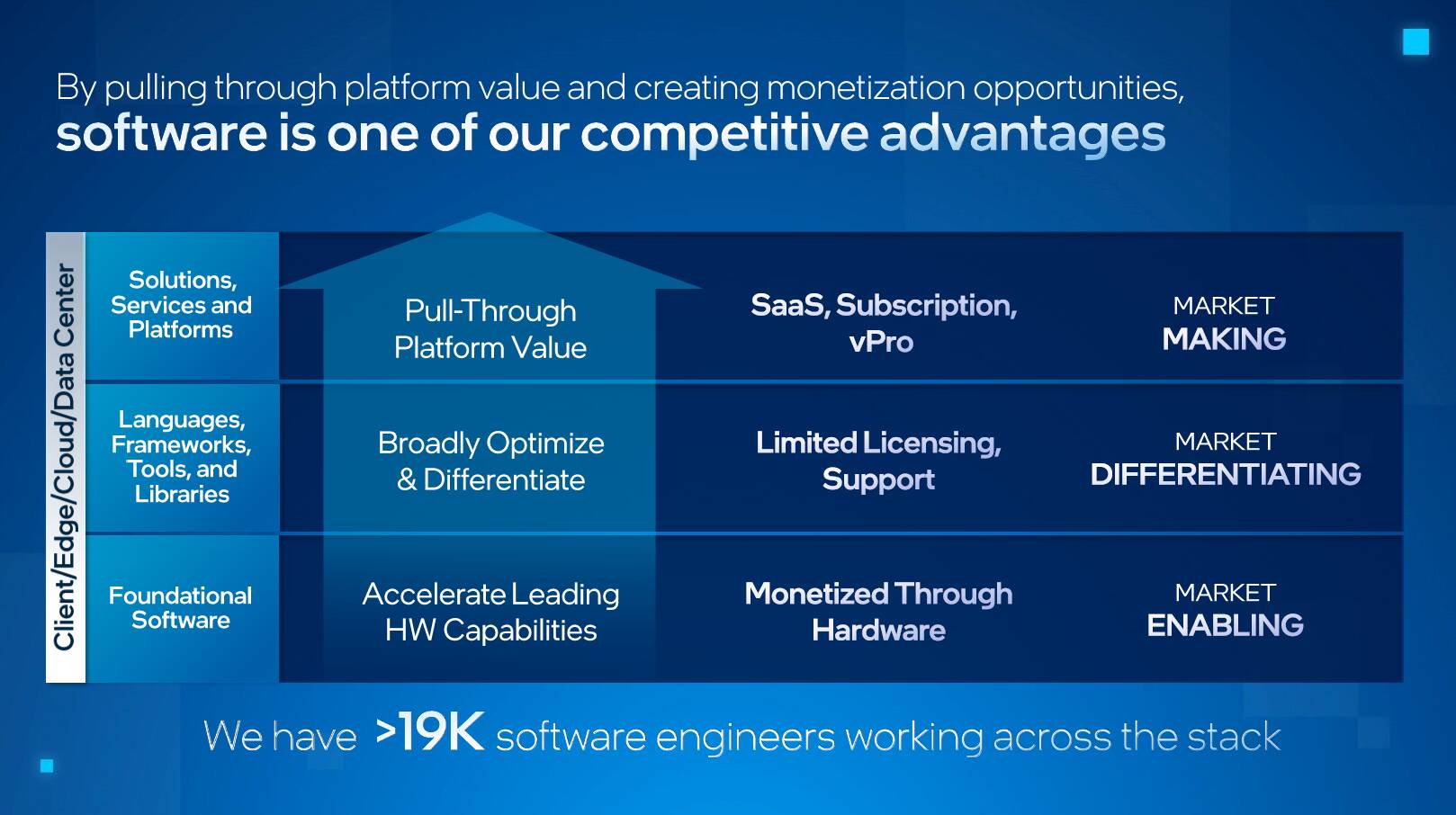
Intel calls this walling-off of chips “software-defined silicon”, which is a disservice to language. Software-defined technology is entirely real and legitimate: for instance software-defined radio replaces analog radio components with digitally-controlled ones, and software-defined networking uses software configuration to set up networks, in place of a bunch of manually-configured d-links. This does not apply here. The Xeon CPUs are already “defined” entirely by the physical silicon printed on the chip. All the features are there the second it’s pressed at the factory. The only thing the software is doing is selectively disabling features and wasting power treating its user as a threat that might horrifically use it without paying enough, all instead of doing whatever actual processing the user might want done.
Intel tried this scheme before, to disastrous result. The “Intel Upgrade Service” from 2010 did exactly this: they shipped processors that didn’t work, then charged an extra fee to use the whole cache and — gasp — threading. It’s an idea that failed completely in 2010, and hopefully won’t fare any better today. And computers could support these anti-features as early as Spring 2022.
These harmful and exploitative systems don’t create themselves; they’re created by morally compromised people who choose to harm others for personal gain.
To close out this hardware-ransoming hell-section, some words of wisdom from Doctorow featuring The battle for Ring Zero, which remains required reading:
Cory Doctorow, “The battle for Ring Zero” There is a vast, important difference between a computer that’s not capable of running unauthorized programs and a computer that refuses to run unauthorized programs. The former is an appliance, while the latter is a device that treats its owner and users as potential attackers whose orders can be countermanded by the device’s manufacturer. Designing a computer that treats the person who depends on it as an attacker is a terrible, nightmarish idea. …
This literally keeps me up at night. It is such an obviously terrible idea to built a world of ubiquitous computers that we put our bodies inside of, that we put inside our bodies, that we trust our whole civilization to, that are all designed to run programs we can’t see or halt.… Esoteric as all this stuff might be, it really worries me. Switching to a default assumption that our computers should control us, not the other way around, is a terrifying, dystopian nightmare.
Cory Doctorow: You bought a thing, you want to fix it — or nominate someone else to fix it for you — and the manufacturer doesn’t. How ever can we resolve this intractable difference of opinion?
It’s a real puzzler. Wait, how about this?
Fuck you, I bought it, it’s MINE.
That’s got a real ring to it, doesn’t it?
…
Manufacturers tie themselves in knots explaining that they should be able to monopolize parts and service for your stuff … The correct answer to all of these claims is “fuck you, I bought it, it’s mine.”
Trickery!
So I’ve talked about legitimate and illegitimate scenarios. What about ones that aren’t as clear?
Remember this rule of thumb: selling things the right way isn’t complicated, and when a situation is tricky, it’s because it’s been made tricky, to trick people. This is usually a corporation being deceptive about the need, or creating the problem themselves.
Car fobs
Let’s go back to car fobs. Traditional car fobs use a cell battery to send a signal to one’s car using radio waves. These signals can do anything that requires low information throughput: lock and unlock doors, pop trunks, lower windows, start engines, etc. While fobs may have been a luxury feature early on, they’re now incredibly standard.
Smart car services that use a website or phone app to control the car remotely over the internet can do all those same things along with more complicated tasks, like adjusting the air conditioning to a specific setting. But connecting over the internet is a service with real costs, unlike radio fobs, and so quite legitimately have subscription fees attached to the service.
But that doesn’t justify car manufacturers not offering service-less fobs as an option. If there’s a feature set that we already have engineered and can be provided cheaply — without requiring the company to pay any costs! — the only reason to kill off that feature is to force people onto your subscription model. This is the broken-window fallacy: destroying something useful so you can sell a replacement isn’t creating value. They’re creating a need for a more expensive solution they can sell you and cutting off your access to the technology that could easily suit your needs without requiring a subscription service at all.
Nintendo cloud save backup
In an example that’s near and dear to my heart (think “war wound”), let’s look at Nintendo’s online cloud save backup service.
This will feel like it overlaps a lot with Nintendo’s rug-pull thievery earlier, and that’s not a coincidence. It’s the same company with the same instincts of greed, control, and fundamental disrespect for individuals. The “rug-pull” isn’t fundamentally different than these deceptive edge cases; this is just the taxonomy I’ve cobbled together.
The Nintendo Switch launched in March 2017 with no save data management system at all. This was a major step backwards from the Wii, Wii U, and 3DS consoles, all of which had systems for backing up data and transferring it between consoles using an SD card.8 Every game console has had save management ever since save data used “files” and wasn’t just written directly onto the cartridge: before SD cards, even the Gamecube had a system for file copying and management on proprietary memory sticks, and every console had two ports to facilitate exactly that.
But the Nintendo Switch, which uses SD cards for game storage and has several other data transfer methods built in, choose instead to restrain users and prevent them from backing up any of their work.
Save management wasn’t even announced until September 2018, where it was brought back in the form of Cloud Saves, which would only be available as part of the Nintendo Switch Online subscription service. This service automatically backs up your game save files to Nintendo’s cloud servers, where they can be restored to another Switch console that’s registered to the same Nintendo account. At all times, the data is controlled entirely by Nintendo, with no agency allowed to the user over how their data is handled or who they can share it with.
And even for customers who pay the recurring fee, save management still isn’t, like, “a thing you get.” Nintendo retains complete discretionary control over which games can have their data secured and actively prevents it on a long list of games including Minecraft, Civilization VI, the FIFA series, most Pokémon games, and Splatoon. Personally, I think this is more due to Nintendo’s obsessive need to maintain an oppressive stranglehold on its users in a violently misguided effort to prevent “cheating”, but the result is awful either way.
So, at the end of the day, what do we have here? Nintendo locks basic features like console save backups to the cloud instead of letting you do basic operations locally. This effectively turns an operation you should be able to do yourself into one you have to pay them for.
Here’s the trickery, though: Nintendo Switch Online is still a good deal for the features it provides. Cloud save backup alone is a great feature to help casual users avoid catastrophe, and is a service worth paying for. But arbitrarily locking protection (the protection of children, no less) against heartbreak behind a paywall by tying people’s hands and preventing them from making their own backups is heinous. It’s not the service that’s awful; it’s the carefully constructed environment it’s offered in. It’s a good value given the artificial constraint, but the constraint itself is illegitimate.
Nintendo has intentionally broken the tools its customers — and, again, their children — need and prevents them from protecting themselves, and so any service they try to sell to undo that damage is disqualified from being “worthwhile” and is instead a key piece in an predatory, overtly evil practice.
Games that lock multiplayer
While we’re on the subject of games, let’s circle back to that idea of multiplayer as a service. The current infrastructure is for clients to connect to servers owned by the vendor, which then either host games directly or perform matchmaking.
Virtually every video game — before the very recent AAA trend — distributed the game hosting software as part of the game, instead of keeping it secret and giving the publisher a monopoly on multiplayer.
Want to play TF2? Just host a server. Valve has its official servers, but anyone who owns the game is free to host their own game or set up a dedicated server with their own rules. If you even suggested wanting to do that with Overwatch, you’re just laughed out of the room. And I’ve already talked about how Minecraft handles this.
Keeping a monopoly on a core feature of the game and not letting the customers actually own it not only gives the vendors incredible power to charge a recurring fee for a basic part of the game users could host themselves, it lets them cut off the “service” whenever they want by shutting down the servers. Plus, if the game depends on servers and the server code has been lobotomized from the copies users buy, game companies can snap their fingers and kill the products people own. Better buy the sequel!
Apple Arcade
Apple Arcade, Apple’s subscription game service launched in 2019, is a weird one. For $5/mo, you get unlimited access to download and play games from a special “Apple Arcade” app store category. The Apple Arcade subscription is the only way to access these games.
These are just locally downloaded phone games without any kind of special Apple service attached. (Unless developers choose to use — *spits* — events.) The games themselves are good. Really good, for mobile games. And the immediate value proposition for the customer is a good deal. But it’s peanuts compared to an actual mobile game market that sells ownership of copies.
Which is something Apple had! Apple Arcade is fundamentally a solution to a problem Apple created themselves and has refused to address for decades: mobile game hell.
In the early days of the App Store, games usually cost around $2, but were also available as a free “lite” version that was ad-supported instead. Some genuinely high-quality games were developed too, like ports of classic games like Bejeweled, Tetris, and Minecraft, but also new franchises like Infinity Blade, the Kairosoft library, and the N.O.V.A. series. These were typically priced at $2-$10, and were genuinely high-quality games sold at an excellent value. These are mostly gone now. So what happened?
As it’s “matured”, the App Store has degenerated into a race-to-the-bottom of “freemium” games saturated with ads and in-app purchases. The in-app purchase model is famously predatory and uses manipulative psychological techniques to draw people in — and even develop literal gambling addictions — to extract absurd amounts of money. Because Apple takes a cut, they encourage developers to use these dark patterns, and have been known to punish developers who avoid the in-app purchase system.
Another way mobile games extract continuous revenue from players is in-app advertising. Ads are generally miserable, but ads in mobile games tend to also be disturbing and incessant. The combination of those two things also makes Apple’s game market extremely unsafe for children to be near, despite children being a major demographic of the mobile gaming market.
Pictured: Apple’s core value proposition
Apple has consciously redirected the massive growth in the mobile games market towards this crapware. Apple has an absolute iron-fisted monopoly over not only the apps allowed on the store, but also what apps the store promotes and prioritizes in recommendations and search results. And Apple has been happy to profit off the dregs of the gaming industry at the expense of the material that was of actual quality to such an extent that “making good video games” became a losing proposition on iOS.
In their own words from their press release:
Paid games are often critically acclaimed and beloved by the people who play them, but competing with free is hard, so even the best of these games have only reached a smaller audience.
Gee, how did that happen?
With Apple Arcade, Apple has made a gesture towards “saving” the market they destroyed by introducing an option worse than what they had already but threw away. Apple is working with major studios and big-name IPs to develop high quality mobile games to make exclusive to Apple Arcade. There are design standards for these games too: no pay-to-win mechanics, no in-app purchases, no advertisements. They’re only funded by the subscription.
But Apple is only having to do all of this because they refuse to directly address the set of perverse incentives they created in the real mobile app market… because as awful as everyone knows the results of that are, it’s making Apple money. Far from “redefining games” as they claim in a sentence that genuinely made me laugh out loud at the audacity, they’re just building a life-support structure around what’s left of the high-quality game market they mutilated.
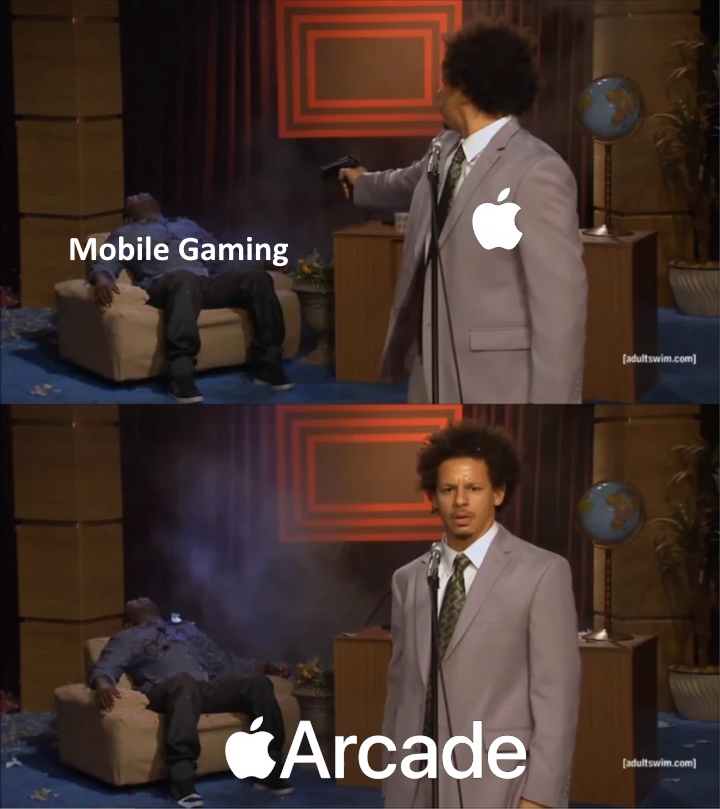
And the high quality of the Apple Arcade games points to another problem at the core of the Apple Arcade proposition. With the low-cost subscription fee, Apple is trying to provide “entertainment by volume” to cater to casual mobile gamers, but simultaneously hand-picking the highest-quality material — games that you would want to pay to own — to make subscription exclusives. It’s a model that’s intrinsically at odds with itself.
But let’s say you want to play a mobile game that isn’t bad, so your only option is something from Apple Arcade. Unlike every other major subscription game service out there, there’s no way to purchase any of these apps. They’re permanently locked behind the subscription model with no way to buy-to-own. And most of these games are licensed as exclusives, so you’re SoL.
And remember how bad Nintendo was with save data? On Apple Arcade, if you cancel your subscription, you lose your save data. You don’t just lose your backups, you aren’t allowed to save your progress anywhere. You have to keep paying, in perpetuity, just in case you might want to revisit a game, ever. Lord almighty. If I was considering investing any amount of energy in Apple Arcade, learning that last bit killed that spark for good. I’d rather to have never loved at all, thank you very much.
This all depends on illegal monopolies
All of this misconduct withers into dust, almost instantly, if competition or repair isn’t being unlawfully suppressed. This misbehavior always thrives in monopolistic, anti-competitive environments. In fact, given the technology we have now, it’s a predictable failure mode.
If there’s no way for other people to “compete” and offer the same service, vendors can get away with higher and higher prices which give them higher and higher profit margin. And eventually, in cases of complete dysfunction, the price tether snaps, and the price the vendor can charge becomes completely disconnected with the costs. This is economic rent; price sustained beyond a competitive level by an artificial barrier.
This is the epitome of “monopolistic behavior”: charging steep prices for something literally any competition would make free overnight. This is another reason why these corporations hate right to repair so much: it would let customers act as the competition themselves. So if you were wondering why the automotive industry is lying about how right to repair policies mean you definitely support sexual predators and/or will get raped outright, that’s why. Profit.
Monopoly creates the leverage for companies to — quoting The End of Ownership — “divide our lives into individual transactions and charge as much as we are willing to pay for each one.” It’s the awful, perpetually monetized, vertically-integrated, vaguely hostile future. Any of these walled, insular software ecosystems create exactly this sort of monopoly.
Tesla can charge whatever it wants for its “software upgrades” without worrying about someone selling software that “provides the same features” (flipping a switch for free) because within the walls of its vehicles Tesla is the only storefront and the only government. Audi can operate its own little monopoly inside its cars where it can charge you for the damn air, and GM soon hopes to carve out exclusive rights over the thoughts you think within its cabins.
As I quoted in the earlier peloton story: “This is the predictable failure-mode of designing devices that can be updated without their owners’ permission or consent.“
The current copyright doctrine gives Nintendo a blank check to provide people with exactly the games and experiences it pleases at any given moment, regardless of what games people actually own and what services they paid for. Within its legally carved-out conceptual sphere of ownership, Nintendo has a monopoly over even second-hand-sales.
And of course the only reason Nintendo can charge money for file services is that it’s been able to lock down its software ecosystem. And to its great advantage! We can see what it would be up against in the Switch Homebrew community, where the “competition” to its cloud backup racket are free and open source save management tools people have made for the joy of it. The only way to make money off people when that software exists is to make sure people never get a chance to use it.
Not creating value!
What’s the common theme in the illegitimate cases? Companies are charging for allowing value to exist instead of actually creating any. Instead of creating value, they’re gatekeeping it.
And this is why profiting off access instead of production is an inherently bad model. Selling produce delivers value and incentivizes actual innovation and development, but selling “access” inevitably ends in this rent-seeking, ransoming, gunpoint model where “vendors” do nothing but charge their customers extortion money to postpone harming them. This is what happens when the business stops being about the product and devolves into just generating the maximum amount of revenue through whatever means are available.
Price needs to be tied somehow to the costs. It can’t just be arbitrary, like we see in subscriptions. As soon as companies can leverage monopoly sustain an arbitrary price beyond the competitive layer, it rises to the absolute maximum anyone will pay. (See: dynamic pricing.) Contrary to what the financialization suits want, success can’t just be “make people willing to give us money” because that description would paint literal robbery at gunpoint as a highly effective strategy for creating demand and generating predictable revenue streams. Profit is not a per-se justification.
People act as if “business” is supposed to be when people give you however much money you demand because you have the divine right of kings, instead of payment in exchange for goods and services. Oh, boo hoo. Does someone’s business model have actual costs and risks associated with it? Are you being asked to do something other than sit comfortably in a position of power and demand money?
As soon as you start hearing “we need to make our product less useful in order to be fairly compensated for our labor”, that’s an indicator that the correct compensation for that labor is zero. Zilch. If anything it should be a negative, because the thing the labor is working towards is causing harm and intentionally introducing defects. What they’ve done is created a modern miracle and then intentionally spoiled it because it cured the problem they only wanted to sell a treatment for. That’s not value-producing work that needs extra systems built around it to ensure that it’s profitable, that’s just vandalism.
This is all very well-trod ground. Subscriptions are illegitimate when they’re used to charge economic rent, when a gatekeeper makes a profit by controlling access to something that already exists instead of producing new value. This is economic rent, rent-seeking behavior, digital feudalism.
Corporations act like pointing this out is an attack against them and a dangerous communist plot that should be treated as a national security threat. In actuality, it’s just the ol’ Macroeconomic Changes Have Made It Impossible for Me to Want You to Not Have to Pay Me More Money. They pretend it’s a seizure against them when people expect them to lose a degree of control over the products they sell. But that’s what “selling” is. Selling gives the buyer rights over the item, it’s not when people give you money for nothing.
Companies want to be able to maximize what they can charge while doing as little as possible, because that’s what companies are built to do. That’s their job. It’s our job not to let them.
Related Reading
- Victoria Song, “In the Future, You Won’t Own Any Gadgets”
- Aaron Perzanowski and Jason Schultz, “The End of Ownership: Personal Property in the Digital Economy”
- Cory Doctorow, “The battle for Ring Zero”
- Dan Greene, “The erosion of personal ownership”
- Ida Auken, “Welcome To 2030: I Own Nothing, Have No Privacy And Life Has Never Been Better”
- Simon Caine, “How did everything become a monthly fee?”
- Cory Doctorow, “Autoenshittification (24 July 2023)”
Concepts
Goods, Services, and Software
- WIPO, About the Nice Classification
- Kara Novac, “EU Court: When You Buy Software You Own It”
- The Economist, “Take back control: How Digital Devices Challenge the Nature of Ownership”
- University of Arizona, “Decoding digital ownership: Why your e-book might not feel like ‘yours’”
- Brian W. Carver, “Why License Agreements Do Not Control Copy Ownership: First Sales and Essential Copies.”
- Cory Doctorow, “Did Congress Really Expect Us to Whittle Our Own Personal Jailbreaking Tools? | Electronic Frontier Foundation”
Car Hell
- Jason Torchinsky, “BMW’s New Feature Subscription Plan Idea Needs To Be Stopped Before It Starts”
- Theo Wayt, “Auto giants like BMW, GM and Toyota make drivers ‘subscribe’ for basic features”
- James Vincent, “BMW starts selling heated seat subscriptions for $18 a month”
- Victor Tangermann, “BMW Now Selling Drivers Access to Their Cars' Heating Systems for $18 Per Month: Welcome to Microtransaction Hell”
- Ekaterina Kachalova, “As more automakers put factory features behind paywall, we’re racing towards a bleak future”
- Spite’s Corner, “KTM's Demo Mode Is A SCAM! | 2023 KTM 890 Adventure”
Other Products
- Alex Hern, “Revolv devices bricked as Google’s Nest shuts down smart home company” (2016)
- Arlo Gilbert, “The time that Tony Fadell sold me a container of hummus”
- Karl Bode, “Anker Tries To Bullshit The Verge About Security Problems In Its Eufy ‘Smart’ Camera”
- Cory Doctorow, “Peloton bricks its treadmills — Your kids are dead because you didn’t buy the subscription”
- “Clip Studio Paint announces move to subscription service for updates going forward” ResetEra thread
- James Stephanie Sterling, “Subscriptions For Car Seats!?” (Video)
- Stephen Shankland, “Adobe kills Creative Suite, goes subscription-only”
- Kate “ghost malone” Stears, “Fuck the Adobe Suite: Use These Instead”
- Kate “ghost malone” Stears, “Stop Using Photoshop You Broke, Beautiful Bastard”
- Mel Martin, “I’m Falling out of Love With Adobe and the Creative Cloud”
Capitalism
- Economic rent - Wikipedia
- Kamilla Pope, “Understanding Planned Obsolescence: Unsustainability Through Production, Consumption and Waste Generation”
- Cory Doctorow, “Felony Contempt of Business Model: Lexmark’s Anti-Competitive Legacy”
- Cory Doctorow, “Radicalized” ($14)
- Karl Bode, “Kia, Subaru Disable Useful Car Features, Blames Mass. Right To Repair Law”
- Ed Zitron, “The Rot Economy”
- Yugopnik, “Capitalism makes sh!t products”
Unsorted
- Janica Bunales, “Spotify Lowers Artist Royalties Despite Subscription Price Hike”
- CaptainKrull, “[Guide] iOS Subscription Time Travel or how to buy subscription-based apps before they turn to the dark side : sideloaded”
- Thoughtslime, “The Grift Economy: Everything is a scam, always.” (video)
- Rick Broida, “FCC asks Apple to activate the iPhone’s hidden FM radio to aid public safety”
- Dan Singer and Enrico D’Angelo, “Why subscription video-game services face an uphill battle”
-
Written for Harvard Magazine in 2000, when “cyberspace” was both the hot thing and still a safely contained thought experiment. ↩
-
Well, up until the very recent past, when Microsoft began unilaterally moderating conduct and handing out bans in private servers. ↩
-
Microsoft has a first-party Minecraft server hosting service called “Realms”, but it started long after community servers were the norm, and took guidance from the existing system on how to competitively price the service. With Bedrock and other pushes Microsoft is obviously trying to push Minecraft towards a rent-seeking game-as-a-service model, but, at least for now, the full game still exists. ↩
-
Although in practice these remedies are often in the form of service credits, and indemnification is bounded by contract-specific limitation of liability clauses. Regardless of the specifics, these are remedies consumers don’t get. ↩
-
A key piece of our plan to bring about the one world government, apparently ↩
-
With some minor licensing modifications. See Virtual_Console_(Wii)#Differences for some examples. ↩
-
I can attest to this personally; I own a Clip Studio Paint Ex perpetual license, and was denied the request for a refund I made when they announced they would no longer be honoring it. ↩
-
3DS save management was notably limited compared to previous devices, a step toward the total shutdown of the Switch era. ↩