What Was The Beginner's Guide About?
- 41 min read (1+ hr w/ quotes)
- Posted in literature
What Was The Beginner's Guide About?
 Interloper and Artistry in Impressionistic Horror
Interloper is an unfiction ARG series for source nerds. It feels like Interloper was laser-targeted to drive me specifically insane, but it turns out that was true for a lot of people. After three years the first episode has 856k views, and the recently released final episode is a feature-length 1:54 film that earns its runtime.
I’ve been obsessing about Interloper since the beginning, and when I saw the finale I knew I had to finish it out properly. But this article is my third attempt to write something about Interloper, after spending several weeks just doing research.
My first instinct after seeing the finale was to “solve” it. There was an enormous amount of information available that was all interconnected and painted a picture of this huge, fascinating world. Interloper F didn’t answer all the questions the series asked, but surely with all the clues it gave us, someone who really understood the series would put the pieces together. Surely I could, if I gave it some time and attention.
But that didn’t work.
Fandom and The Freedom Motif
Fandom is the most important thing in the modern media industry. Fans buy the products and advertise the brand, but are also the primary source of feedback. The media is what the community forms around, but the community is what feeds the media.
But the relationship between a work’s copyright holder and its fan community is structurally antagonistic. The IP holder and members of the fan community have fundamentally different interests which sometimes align but sometimes don’t. The rightsholder depends on the goodwill of the fandom, but at the same time there is always danger of the community being attacked by the rightsholder. The law creates an implicit hovering threat of legal violence, and the profit motive encourages bad actors to pull the trigger. This doesn’t mean the relationship has to be antagonistic in practice, but it means there is always an underlying potential for conflict that has to be reasoned with. The threat is always there.
There is a productive tension here. Fanwork can serve functions official work can’t, and the community surrounding a work is one of the main things that gives a work “value”, in a base economic sense. They’re the ones buying the products. Media companies are desperate to have more fans because that directly translates into their ability to make money.
Likewise, the health of the franchise matters to the people who love it, and official recognition of fan communities can be a good thing.1 Fan work can be elevated, talented creators can be brought on as part of official projects, etc. Official recognition can serve as a badge of honor and help platform and encourage talent and creativity in the community.2
But the deciding factor in whether the creator/fan relationship is healthy or exploitative is whether the community is allowed to be independent. It’s fine for official spaces — fourms, Discord servers, etc. — to exist, so long as the purpose isn’t to capture and enclose a community. Media and fandom can have a symbiotic relationship, but as soon as the corporation tries to exercise control over their fans, it turns into an ugly hostility.
Can You Keep a Secret?
Deltarune came out! Weirdly, that’s kind of a problem? People who care about the game have this immediate need to stay off social media so as not to be spoiled. There is a rush to for anyone who ever wants to play the game to do so immediately, because if you don’t the Internet will ensure you don’t get a blind experience. You’re forced to binge it or be spoiled.
I was just thinking about chapter 2, and how I would’ve loved to have found the secret twist for myself, even though it was hidden away a little. If the game has indicated there was something to find, people would have found it on their own. Instead, I’m willing to bet the experience for the vast majority of people was finding out online first and then reproducing what they saw for themselves.
But this is not a Deltarune thing. For any narrative media, the experience depends on the work presenting the narrative flow it intends to. This includes reveals, this includes pacing, this includes characterization.
Getting information out of turn spoils the game. It does this so aggressively that breaking narrative flow has become one of the definitions for the word “spoil”, as in “ruin”. I have a much longer piece I want to write some day about information filtering in general, which is maybe the hardest problem ever?
For games like Deltarune, it’s taken for granted that people have at most a week of courtesy before the Internet is flooded with information. And of course there are some people out there who are eager to get that information as soon as possible; it is not universally true that people want to experience narrative as intended.
But is this a little silly? Is narrative purity so reverential that information should not flow through the normal channels by which ideas are pushed to us, like social media?
Here’s what piqued my interest about this today: gaming does have a reverence for not letting experiences be spoiled. It’s just very selective right now. We see this absolute demand that knowledge not be leaked, that games be allowed to communicate information to the player on their own terms. But beyond extremely new releases, we see this almost exclusively with regard to knowledge-based games or metroidbrainias, where knowledge is the gameplay mechanic.
 SUPERHOT VR's Story was Removed. What?
SUPERHOT VR released in 2017. Then in 2021 the game’s entire story was removed.
What’s happened here is fascinating, but somehow nobody has talked about it seriously. Because it’s censorship in a video game — a topic the gaming community cannot be normal about — it is nearly impossible to even think about the issue through all the noise. Anyone aware of this topic at all seems to be screaming about Woke, or complaining about games becoming “political”, as if “political” is just a switch you can throw to make media worse.
Wikipedia summarizes the discourse as:
The choice to remove these games led to the game getting review bombed on Steam, with some users claiming that Superhot Team was giving in to “snowflakes” and others believing it to be a form of virtue signaling.
But this is insane! A historically significant VR game — one of the greatest of all time — had one of its defining characteristics removed, without any explanation or replacement. This isn’t some Stellar Blade fake controversy, something weird happened here. There are real, understandable things to object to, and none of them are right-wing culture war buzzwords.
SUPERHOT was originally developed for the 2013 7 Day FPS Challenge game jam by Polish team “The Bricky Blues”, directed by Piotr Iwanicki. In September 2013 it was released on the Blue Brick Software and Embedded Systems website in three separate “episodes” because the levels were developed in parallel in three separate unity projects for the jam.
After the demo received positive feedback, SUPERHOT went to Kickstarter (after they got Kickstarter to support Poland) and was successfully overfunded in June 2014. (With the success of SUPERHOT, the Blue Brick company seems to have been abandoned.) SUPERHOT (2016) was then released in February.
Events in games bother me
I don’t like “events”. I don’t like it when things are limited with requirements of spacial presence and time. I don’t like experiences that only exist in one moment and then can never be relived. I don’t like ephemera. I prefer things. Toys I can play with, tools I can use, books I can read, movies I can watch, all at my own discretion. I have agency over my things. The actual lived experience from occurrence to occurrence is always different, of course, but the externalities can be repeated. I love being able to preserve the essence of a thing.
It’s one of the reasons I like computers. Or maybe it’s a psychological trait I developed because I had access to computers growing up. It probably is, I think. But either way, I love the purity of digital storage and interface. I love having an environment where experiences can be preserved and replayed at my discretion without my having to make any demands on other people.
And so that’s one of the reasons I love video games. Their mechanics are defined and can be understood and mastered. Their levels are defined and can be understood and mastered. Despite the extreme rates of “churn” — video games go out of print much faster than books or other physical media — the software is digital, and can be saved, stored, and replayed. I can look up the flash games I played as a kid and replay them, exactly as they were, and understand myself a little better for it.
Of course there are exceptions; it’s impossible to have a multiplayer game without an implicit demand that other people play with you. When an old game “dies”, it’s often not because the necessary hosting software is being intentionally withheld, but that there just isn’t a pool of people casually playing it like there used to be. That’s still a loss, and it’s sad, but that’s an unavoidable reality, and it’s not nearly as complete a loss as a one-off event being over.
So I don’t like when games force seasonal events on me. Limited-time events introduce something new, but they also necessitate the inevitable loss of that thing. And that assumes you were playing everything from the start; events introduce content that can be “missable” in a meaningful way, so if you’re weren’t playing the game at the right time, even if you own the game and finish everything you can access your experience can still be rendered incomplete. One of the things I like about games is that they’re safe, and the introduction of time-based loss compromises that safety.
That constant cycle of stress and pressure to enjoy things before they were lost is one of the main reasons I stopped playing Overwatch. I realized the seasonal events in particular weren’t good for me; they turned a game that should have been fun into an obligation that caused me anxiety.
But I’ve been thinking about this lately not because of Overwatch, but because Splatoon 3 is coming out soon. Splatoon isn’t nearly as bad as all that, I don’t think it’s deliberately predatory aside from Nintendo’s standard insistence on denying people autonomy. Splatoon 3 invokes that “people will stop playing Splatoon 2” loss, but even before that, Splatoon (a game I love) left a bad taste in my mouth because of its events.
 The Génocidaires: People
Now, a lot of people pushing the anti-trans agenda aren’t actually murderers or overt political fascists. The extremists are still the extremists. Moderates sustain these genocidal movements, but they don’t drive them. Unlike the center, the people who rise to the top are always the ones drawn to the movement because of its viciousness. It still matters, though, whether the people towards the middle are willing to help them or not.
It’s still true that legislators and anti-trans activists are not pursuing moderate treatment (psychotherapy, etc); they’re distinctly aiming for obliteration. But that message only works for people who agree with those people openly willing to back genocide outright, or people who can agree with the lampshade.
Even most of the republicans don’t actually know the people they’re voting for are full-on cuckoo-bananas. But the “socially liberal, fiscally conservative” types end up pushing this agenda, even if they’re unaware. People see a ballot where one choice describes a more convenient world for them, and they tick it. They’re not supposed to think about the violence it takes to make that happen.
People like framing the idea of pride like they frame the abolition of slavery or civil rights: as a celebration of a positive political change that happened in history, rather than an ongoing conflict. As soon as pride feels like a conflict, it feels like a conflict they’re on a side of, because they are.
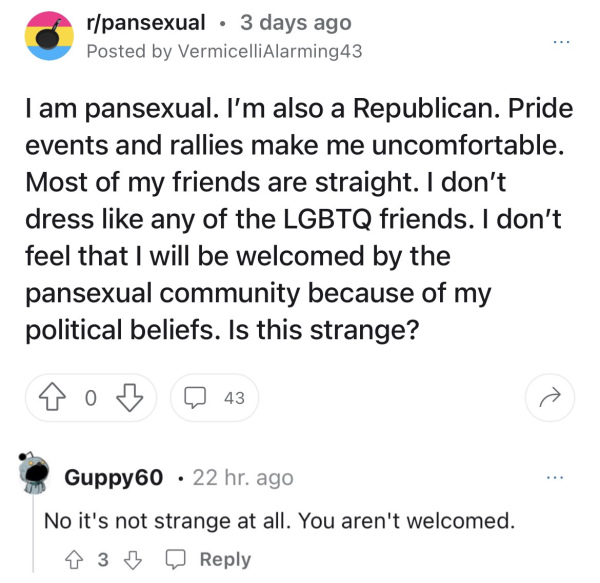
A lot of the people helping propel the cause of genocide don’t actually believe in the case for genocide; the genocidalists depend heavily on people buying the euphemism. That’s another topic I want to do a longer piece on someday, but here’s a brief summary on how rhetoric works on marks.
The mark says they don’t want children to be abused. Now, the people pushing the anti-abuse laws don’t care about children being abused, and their laws don’t prevent abuse, but anti-abuse is the euphemism they’re using to disguise their intents, and the mark agrees with that euphemism, so they think they must agree with the policy. In effect, the fascist hijacks the legitimate cause, just like they hijack institutions.
Even though the marks would, in isolation, be opposed to the real agenda of genocide, they believe enough in the cover story that they show up to support the genocidal cause.
Another key factor in why people support policies they disagree with is the so-called Shirley Exception. Transphobic culture and legislation are both perceived as uncomfortable and inconvenient for a few people — adding some hoops they have to jump through — but they’re usually not seen as being explicitly genocidal.
Psycholonials Commentary, selections
The following are exerpts from my fully transcribed playthrough of Psycholonials, which I wrote last summer. If you aren’t familiar with psycholonials or haven’t played the game, I recommend reading that to catch up.

If you’ve already played Psycholonials though, here’s some food for you. Exerpts though, not the whole thing.
 You can Google it
The other day I had a quick medical question (“if I don’t rinse my mouth out enough at night will I die”), so I googled the topic as I was going to bed. Google showed a couple search results, but it also showed Answers in a little dedicated capsule. This was right on the heels of the Yahoo Answers shutdown, so I poked around to see what Google’s answers were like. And those… went in an unexpected direction.
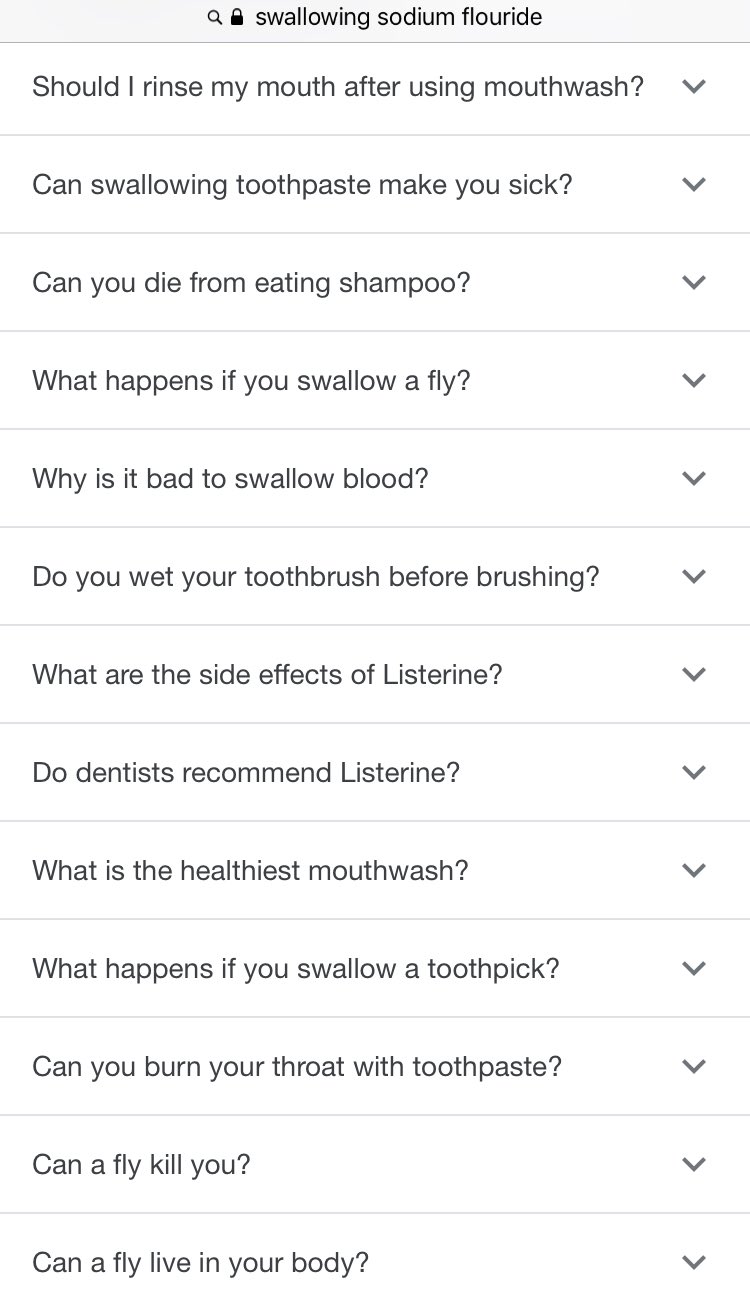
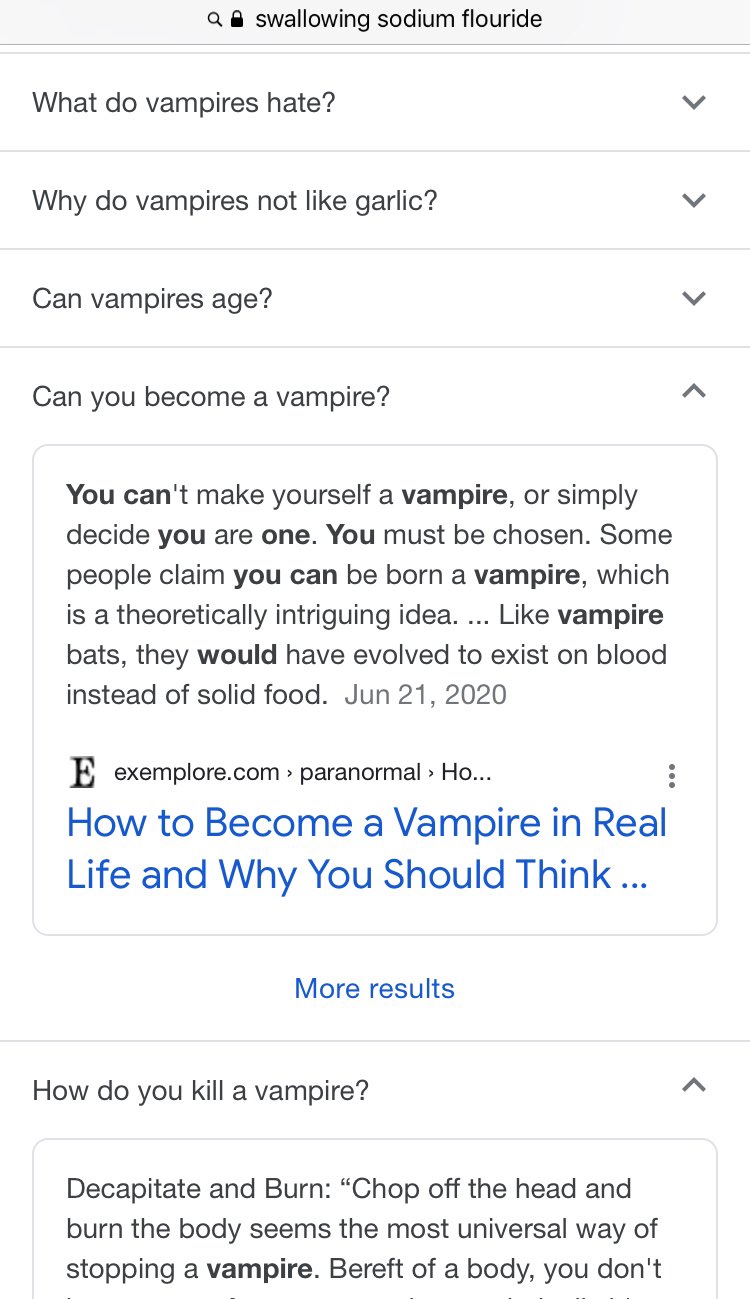
Replying to giovan_h:Fri Feb 26 07:40:22 +0000 2021me: so should I induce vomiting or
google: here’s how and why to drink human blood
So, Google went down a little rabbit trail. Obviously these answers were scraped from the web, and included sources like exemplore.com/paranormal/ which is, apparently, a Wiccan resource for information that is “astrological, metaphysical, or paranormal in nature.” So possibly not the best place to go for medical advice. (If you missed it, the context clue for that one was the guide on vampire killing.)
There are lots of funny little stories like this where some AI misunderstood a question. Like this case where a porn parody got mixed in the bio for a fictional character, or that time novelist John Boyne used Google and accidently wrote a video recipe into his book. (And yes, it was a Google snippet.) These are always good for a laugh.
Sat Apr 27 10:36:51 +0000 2019thanks google
Tue Jan 17 18:04:08 +0000 2017honestly this is still my favourite AI misunderstanding
The Google search summary vs the actual page

— insomnia club (@soft) October 16, 2021
Wait, what’s that? That last one wasn’t funny, you say? Did we just run face-first toward the cold brick wall of reality, where bad information means people die?
Well, sorry. Because it’s not the first time Google gave out fatal advice, nor the last. Nor is there any end in sight. Whoops!
 The Joy of RSS
During the years when Homestuck updated regularly, I usually had some sort of update notifier that pinged me when a new page was posted. But since Homestuck usually updated daily, I ended up just keeping a tab open and refreshing it. And that’s pretty much how I kept up with other serial media on the internet, for years. A writing blog that posts regular updates? Keep a dedicated tab open and refresh it occasionally. Comic? Tab. To this day, I have a “serial” browser window that’s just tabs of sites I check regularly. (Or imagine I might want to check regularly, at least.)
 please don’t tell anyone how I live
Of course, this is terrible. The biggest problem is browser tabs are expensive. If you have a tab open, that takes up a dedicated chunk of memory, even when you’re not reading anything. CPU too, probably, if the site has JavaScript running on it (which is to say, is either decades out of date, or this one). Not to mention the clutter.
Unfortunately, dedicated browser tabs fit specific use case of keeping up with serial media well. Social media feeds — all of them, Twitter, Facebook, Tumblr, Reddit, YouTube — are explicitly “media aggregators”, services that combine multiple media sources into one feed. This is no good for serial media. If you’re following multiple sources, they likely update on different schedules, and updates from the more active ones will bury updates from those slower. Even email updates have this problem. No, you need a dedicated space for each source (but not each update), which a dedicated browser tab will get you.
There is a good system for this, though: RSS.
RSS (Really Simple Syndication) is a fantastic technology that has fallen out of favour in the mainstream lately. It works like this: the media source puts up a small file somewhere that notes the dates, titles, and (optionally) content of posts. And that’s it. There’s no API, it’s just a file people can read if they want. It’s like traditional syndication, but instead of selling articles to multiple distributors (as with syndicated cartoons), you’re distributing articles to many consumers directly.