Tagged: platforms

Ethical Source is Hot Garbage

  • Posted in cyber

Sometimes we talk about someone ā€œhaving brain wormsā€. It’s a metaphor that invokes the idea of having your mind so thoroughly infested with an idea to the point of disease. As with the host of an infestation, such a mind is poor-to-worthless at any activity other than sustaining and spreading the parasite.

A ā€œpersistent delusion or obsessionā€. You know, like when you think in terms of legality so much you can’t even make ethical evaluations anymore, or when you like cops so much you stop being able to think about statistics, or the silicon valley startup people who try to solve social problems with bad technology, or the bitcoin people who responded to the crisis in Afghanistan by saying they should just adopt bitcoin. ā€œBad, dumb thingsā€. You get the idea.

And, well:

There’s a lot of backstory loaded into this interaction, so let me work backwards from here.

The Mastodon Context

The ā€œheā€ Mastodon is referring to is ex-president-turned-insurrectionist Donald Trump, who, because his fellow-insurrectionist friends and fans are subject to basic moderation policies on most of the internet, decided to start his own social network, ā€œTruth Socialā€. In contrast to platforms moderated by the ā€œtyranny of big techā€, Truth Social would have principles of Free Speech, like ā€œdon’t read the siteā€, ā€œdon’t link to the siteā€, ā€œdon’t criticise the siteā€, ā€œdon’t use all-capsā€, and ā€œdon’t disparage the site or usā€.

There are a lot of problems here already, but because everything Trump does is terrible and nobody who likes him can create anything worthwhile, instead of actually making a social networking platform, they just stole Mastodon wholesale.

Mastodon is an open-source alternative social networking platform. It’s licensed under an open license (the AGPLv3), so you are allowed to clone it and even rebrand it for your own purposes as was done here. What you absolutely are not allowed to do is claim the codebase is your own proprietary work, deliberately obscure the changes you made to the codebase, or make any part of the AGPL-licensed codebase (including your modifications) unavailable to the public. All of which Truth Social does.

So that’s the scandal. And so here’s Mastodon poking some fun at that.

The Joy of RSS

  • Posted in tech

During the years when Homestuck updated regularly, I usually had some sort of update notifier that pinged me when a new page was posted. But since Homestuck usually updated daily, I ended up just keeping a tab open and refreshing it. And that’s pretty much how I kept up with other serial media on the internet, for years. A writing blog that posts regular updates? Keep a dedicated tab open and refresh it occasionally. Comic? Tab. To this day, I have a ā€œserialā€ browser window that’s just tabs of sites I check regularly. (Or imagine I might want to check regularly, at least.)

a lot of tabs please don’t tell anyone how I live

Of course, this is terrible. The biggest problem is browser tabs are expensive. If you have a tab open, that takes up a dedicated chunk of memory, even when you’re not reading anything. CPU too, probably, if the site has JavaScript running on it (which is to say, is either decades out of date, or this one). Not to mention the clutter.

Unfortunately, dedicated browser tabs fit specific use case of keeping up with serial media well. Social media feeds — all of them, Twitter, Facebook, Tumblr, Reddit, YouTube — are explicitly ā€œmedia aggregatorsā€, services that combine multiple media sources into one feed. This is no good for serial media. If you’re following multiple sources, they likely update on different schedules, and updates from the more active ones will bury updates from those slower. Even email updates have this problem. No, you need a dedicated space for each source (but not each update), which a dedicated browser tab will get you.

There is a good system for this, though: RSS.

RSS (Really Simple Syndication) is a fantastic technology that has fallen out of favour in the mainstream lately. It works like this: the media source puts up a small file somewhere that notes the dates, titles, and (optionally) content of posts. And that’s it. There’s no API, it’s just a file people can read if they want. It’s like traditional syndication, but instead of selling articles to multiple distributors (as with syndicated cartoons), you’re distributing articles to many consumers directly.

YouTube broke links and other life lessons

  • Posted in cyber

This morning YouTube sent out an announcement that, in one month, they’re going to break all the links to all unlisted videos posted prior to 2017. This is a bad thing. There’s a whole lot bad here, actually.

Edit: Looks like Google is applying similar changes to Google Drive, too, meaning this doesn’t just apply to videos, but to any publicly shared file link using Google Drive. As of next month, every public Google Drive link will stop working unless the files are individually exempted from the new security updates, meaning any unmaintained public files will become permanently inaccessible. Everything in this article still applies, the situation is just much worse than I thought.

The Basics

YouTube has three kinds of videos: Public, Unlisted, and Private. Public videos are the standard videos that show up in searches. Private videos are protected, and can only be seen by specific YouTube accounts you explicitly invite. Unlisted videos are simply unlisted: anyone with the link can view, but the video doesn’t turn up automatically in search results.

Unlisted videos are obviously great, for a lot of reasons. You can just upload videos to YouTube and share them with relevant communities — embed them on your pages, maybe — without worrying about all the baggage of YouTube as a Platform.

What Google is trying to do here is roll out improvements they made to the unlisted URL generation system to make it harder for bots and scrapers to index videos people meant to be semi-private. This is a good thing. The way they’re doing it breaks every link to the vast majority of unlisted videos, including shared links and webpage embeds. This is a tremendously bad thing. I am not the first to notice this.

See, I just kind of sighed when I saw this, because this isn’t the first time I’ve lived through it. On March 15, 2017, Dropbox killed their public folder. Prior to that, Dropbox had a service where you could upload files to a special ā€œPublicā€ folder. This let you easily share links to those files with anyone — or groups of people — without having to explicitly invite them by email, and make them register a Dropbox account. Sound familiar?

Twitter Blue is a late-stage symptom

  • Posted in cyber

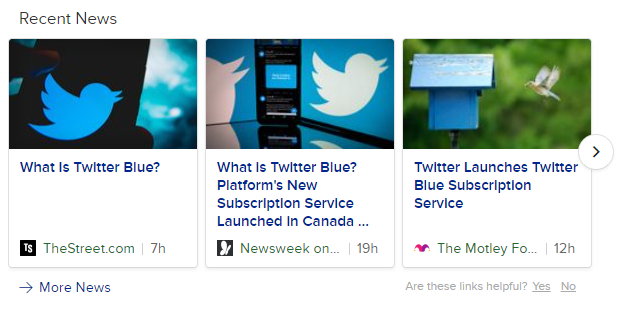
Twitter Blue! $5/mo for Premium Twitter. It’s the latest thing that simply everyone.

News articles about twitter blue

I have an issue with it, but over a very fundamental point, and one Twitter shares with a lot of other platforms. So here’s why it’s bad that Twitter decided to put accessibility features behind a paywall, and it isn’t the obvious.

Client/Server architecture in 5 seconds

All web services, Twitter included, aren’t just one big magic thing. You can model how web apps work as two broad categories: the client and the server. The client handles all your input and output: posts you make, posts you see, things you can do. The server handles most of the real logic: what information gets sent to the client, how posts are stored, who is allowed to log in as what accounts, etc.

Trouble a-brewin' at Redbubble

  • Posted in fandom

Homestuck is once again lit up over fan merch. Homestuck and fan merch have a long and troubled history, but this latest incident is between artists, Redbubble, and Viz media. Here are my thoughts on that!

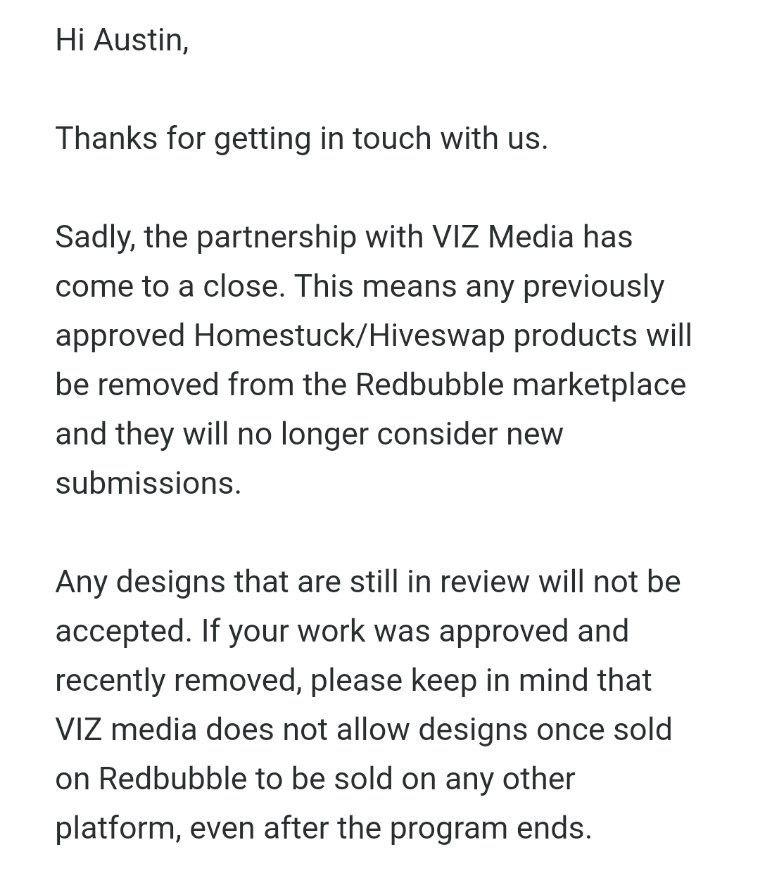
In late May 2021, artists who sold Homestuck merch on Redbubble got this email:

Dear [name],

Thank you for submitting your fan art for Homestuck and/or Hiveswap as part of Redbubble’s Fan Art Partner Program.

At this time, our partnership with the rights holder VIZ Media has come to an end. When a partnership expires, we are required to remove officially approved artworks from the marketplace. This means that your Homestuck and/or Hiveswap designs will be removed from Redbubble soon.

Here are a couple of things to keep in mind:

  • It is important to know that licensors do not allow previously approved designs once sold on Redbubble to be sold on any other platform, even after the program ends.
  • Because this removal is not in response to a complaint, your account will not be negatively impacted.

Partnerships come and go, but don’t worry. We’re looking forward to partnering with more awesome brands in the future.

Check out our Current Brand Partnerships list to see all the properties that are actively accepting submissions. For additional information, we recommend checking out the Fan Art Partner Program FAQ.

Thank you, Redbubble

This hit a lot of people, and hit them hard:

Rut-roh!

Unfortunately for Twitter and brevity this is actually the intersection of a couple different complicated issues, which I’ll try to summarize here.

Just gonna get this one out of the way right off the bat. Copyright law gives IP owners a tremendous amount of power over what’s done with their characters and designs, even extending far into derivative fanart. If you own Homestuck, you actually can take someone to court over selling merch of their fantroll, and probably win. That’s not a great starting point, but it’s the truth.

Eevee has a great write-up of why this is bad. I’d also point you to Tom Scott’s video about how copyright law isn’t designed for intermediate platforms like Redbubble, but suffice it to say, yeah, copyright law really sucks for fanartists, actually.

This is the most complex thing going on here, certainly, but it’s not new and interesting. What is new and interesting, though, is

Redbubble forcing predatory licensing on people

Now, copyright law sucks for fanartists, but that doesn’t explain what happened here.