Recent tech trends have followed a pattern of being huge society-disrupting systems that people don’t actually want.
Worse, it then turns out there’s some reason they’re not just useless, they’re actively harmful.
While planned obsolescence means this applies to consumer products in general, the recent major tech fad hypes — cryptocurrency, “the metaverse”, artificial intelligence… — all seem to be comically expensive boondoggles that only really benefit the salesmen.
It’s a narrative that’s very much in line with what a disillusioned tech consumer expects.
There is a justified resentment boiling for big tech companies right now, and AI seems to slot in as another step in the wrong direction.
The latest tech push isn’t just capital trying to control the world with a product people don’t want, it’s burning through the planet to do it.
But, when it comes to AI, is that actually the case?
What are the actual ramifications of the explosive growth of AI when it comes to power consumption?
How much more expensive is it to run an AI model than to use the next-best method?
Do we have the resources to switch to using AI on things we weren’t before, and is it responsible to use them for that?
Is it worth it?
These are really worthwhile questions, and I don’t think the answers are as easy as “it’s enough like the last thing that we might as well hate it too.”
There are proportional costs we have to weigh in order to make a well-grounded judgement, and after looking at them, I think the energy numbers are surprisingly good, compared to the discourse.
or, the many people who said movies like Coyote v. Acme that were killed for a tax write-off should be forced into the public domain were right, and here’s why
Copyright is busted, now what?
A healthy system of creative rights, including a balanced form of copyright, is a reciprocal arrangement between creators, consumers, and the commons.
Creators are granted some temporary exclusive rights by the government over qualifying intellectual work in order to incentivize creativity.
These privileges are granted in exchange for creating valuable new information — the existence of which is a contribution to the public good — and for providing it in such a way that others will be able to build on it in the future. It’s an incentive for providing a specific social good, one which the market alone might not reward otherwise.
Fortunately, this is actually how US copyright was designed; see You’ve Never Seen Copyright.
The takeaway from that, though, is not just that there’s a fair version of copyright, but that copyright must look like that fair model.
The fact that such a thing as “good copyright” exists as a sound philosophy is not a broad defense of the word “copyright” itself, it’s an imperative requirement for the legitimacy of any system of power that claims to enforce copyright. The soundness of the philosophy doesn’t legitimate the system of power that shares its name, it damns it for failing its requirements.
When they invoke the philosophy of copyright to justify thuggery, it matters that they’re wrong.
The requirements for reciprocity intrinsic in copyright are how the system must work, but it’s not what actually happens today.
In practice, corporations regularly violate the fundamental principles of creative rights — both in letter and in spirit — and use copyright protections to profit without showing the required reciprocity.
Case studies are fun, but just listing out a bunch of horrors isn’t what I set out to do; that’s just groundwork for thinking about the problem.
What’s important is that they’re a representative sample of a kind of behavior.
With all that established, you can read this with the knowledge that yes, they violate the purpose of the law as written and yes, violations are so regular they seem to define the practice.
So what does it all add up to?
Here’s what I say: If you want out of the deal, so be it.
When someone won’t participate constructively — if they don’t work in good faith, or at least begrudgingly accept the limits the system of copyright puts on them — we stop respecting their claim to special privileges within it as legitimate, and understand it as the double-dealing overreach it is.
As self-evident as it sounds when I say it out loud, this argument is my nuclear option.
This is what I would have to say if it ever got this bad; if, between the two of them, the courts and the corps ever broke the system beyond my last bit of tolerance.
And I’ll be damned if they haven’t done just that.
Legitimacy
In You’ve Never Seen Copyright, I talked about how the word “copyright” can refer to two very different things: either a philosophical basis that justifies copyright as a legal doctrine, or the system of power that describes how copyright is actually enforced, what enforcement looks like, and who it benefits.
But the fact that the power structure has diverged from the original philosophical intent doesn’t just create a communication issue. Yes, it becomes increasingly unclear what people who say “copyright” are talking about, but the legitimacy of the power structure depends entirely on being an implementation of a sound legal doctrine.
Remember when Elon Musk was trying to weasel out of overpaying for Twitter?
During this very specific May 2022-Jul 2022 period, there was a very artificial discourse manufactured over the problem of “fake accounts” on Twitter.
The reason it was being brought up was very stupid, but the topic stuck with me, because it’s deeply interesting in a way that the conversation at the time never really addressed.
So this is a ramble on it. I think this is all really worth thinking about, just don’t get your hopes up that it’s building to a carefully-constructed conclusion. ;)
Argument is stupid
First, to be clear, what was actually being argued at the time was exceedingly stupid. I’m not giving that any credit.
After committing to significantly overpay to purchase Twitter with no requirements that they do due diligence (yes, really!) Elon Musk tried to call off the deal.
That is why we must clear out bots, spam & scams. Is something actually public opinion or just someone operating 100k fake accounts? Right now, you can’t tell.
And algorithms must be open source, with any human intervention clearly identified.
Twitter deal temporarily on hold pending details supporting calculation that spam/fake accounts do indeed represent less than 5% of usershttps://www.reuters.com/technology/twitter-estimates-spam-fake-accounts-represent-less-than-5-users-filing-2022-05-02/ …
This was a pretty transparent attempt to get out of the purchase agreement after manipulating the price, and it was correctly and widely reported as such.
Elon Musk has buyer’s remorse. On April 25, the billionaire Tesla and SpaceX CEO agreed to buy Twitter for $44 billion, but since then the stock market has tanked. Twitter agreed to sell to Musk at $54.20 per share, a 38% premium at the time; today it’s trading around $40.
That’s probably the real reason Musk is spending so much time talking about bots.
I don’t want to get too bogged down in the details of why Elon was using this tactic, but fortunately other people wrote pages and pages about it, so I don’t have to.
Last week, looking for a game to play to wind down at night in bed, I went through my backlog of unplayed Steam games and filtered for something that looked relaxing.
I fished out Gris.
Gris is intriguing, atmospheric, and gorgeously animated. It’s a beautiful indie title.
And I kinda hate it?
In going through these arguments, I’ll also be drawing from a few other sources, in order to give a more comprehensive description of the arguments being made.
The Authors Guild Amici Curiae Brief is a document submitted to the court by The Authors Guild in support of the plaintiff’s argument.
Combining lending with digital technology is tricky to do within the constraints of copyright.
But it’s important to still be able to lend, especially for libraries.
With a system called Controlled Digital Lending, libraries like the Internet Archive (IA) made digital booklending work within the constraints of copyright, but publishers still want to shut it down.
It’s a particularly ghoulish example of companies rejecting copyright and instead pursuing their endless appetite for profit at the expense of everything worthwhile about the industry.
My friend Floober brought some recent changes VRChat is making in chat, and I thought I’d jot down my thoughts.
The problem with the VRC economy is the same problem as with most “platform economies”: everyone is buying lots in a company town.
The Store
This was the precipitating announcement: VRChat releasing a beta for an in-game real-money store.
Paid Subscriptions: Now in Open Beta! — VRChat
Over the last few years, we’ve talked about introducing something we’ve called the “Creator Economy,” and we’re finally ready to reveal what the first step of that effort is going to look like: Paid Subscriptions!
As it stands now, creators within VRChat have to jump through a series of complicated, frustrating hoops if they want to make money from their creations. For creators, this means having to set up a veritable Rube Goldberg machine, often requiring multiple external platforms and a lot of jank. For supporters, it means having to sign up for those same platforms… and then hope that the creator you’re trying to support set everything up correctly.
(The problem, of course, is that “frustrating jank” was designed by VRChat, and their “solution” is rentiering.)
Currently, the only thing to purchase is nebulous “subscriptions” that would map to different world or avatar features depending on the content. But more importantly, this creates a virtual in-game currency, and opens the door to future transaction opportunities. I’m especially thinking of something like an avatar store.
I quit playing VRChat two years ago, when they started to crack down on client-side modifications (which are good) by force-installing malware (which is bad) on players’ computers.
Since then I’ve actually had a draft sitting somewhere about software architecture in general, and how you to evaluate whether it’s safe or a trap. And, how just by looking at the way VRChat is designed, you can tell it’s a trap they’re trying to spring on people.
The Store of Tomorrow
Currently, the VRC Creator Economy is just a currency store and a developer api. Prior to this, there was no way for mapmakers to “charge users” for individual features; code is sandboxed, and you only know what VRC tells you, so you can’t just check against Patreon from within the game1.
But the real jackpot for VRC is an avatar store.
Currently, the real VRC economy works by creators creating avatars, maps, and other assets in the (mostly-)interchangeable Unity format, and then selling those to people. Most commonly this is seen in selling avatars, avatar templates, or custom commissioned avatars.
Users buy these assets peer-to-peer.
This is the crucial point: individuals cannot get any content in the game without going through VRC. When you play VRChat, all content is streamed from VRChat’s servers anonymously by the proprietary client. There are no URLs, no files, no addressable content of any kind. (In fact, in the edge cases where avatars are discretely stored in files, in the cache, users get angry because of theft!) VRChat isn’t a layer over an open protocol, it’s its own closed system. Even with platforms like Twitter, at least there are files somewhere. But VRChat attacks the entire concept of files, structurally. The user knows nothing and trusts the server, end of story.
When I’m looking for an example of copyright abuse, I find myself returningto Nintendoa lot on this blog.
Nintendo is a combination hardware/software/media franchise company, so they fit a lot of niches.
They’re a particularly useful when talking about IP.
Nintendo has constructed a reputation for itself as a “good” games company that still makes genuinely fun games with “heart”, yet it’s also infamously aggressive in executing “takedowns”: asserting property ownership of creative works other people own and which Nintendo did not make.
You’d think a company like Nintendo — an art creation studio in the business of making and selling creative works — would be proponents of real, strong, immutable creative rights. That, as creators, they’d want the sturdiest copyright system possible, not one compromised to serve the interests of any one particular party.
This should be especially true for Nintendo even compared to other studios, given Nintendo’s own fight-for-its-life against Universal in its youth, and its relatively small position1 in the market compared to its entertainment competitors Disney, Sony, and Microsoft.
But no, Nintendo takes the opposite position. When it comes to copyright, they pretty much exclusively try to compromise it in the hopes that a broken, askew system will end up unfairly favoring them. And so they attack the principles of copyright, viciously, again and again, convinced that the more broken the system is, the more they stand to profit.
Introducing Nintendo
Nintendo, even compared to its corporate contemporaries, has a distinctly hostile philosophy around art: if they can’t control something themselves, they tend to try to eliminate it entirely.
What Nintendo uses creative rights to protect is not the copyright of their real creative works, it’s their control over everything they perceive to be their “share” of the gaming industry.
Let me start with a quick history, in case you’re not familiar with the foundation Nintendo is standing on.
Nintendo got its footing overseas by looking to see what video game was making the most money in America, seeing it was Space Invaders, and copying that verbatim with a clone game they called “Radar Scope”:
This got Nintendo in trouble, and it was almost itself the victim of an abuse of IP law.
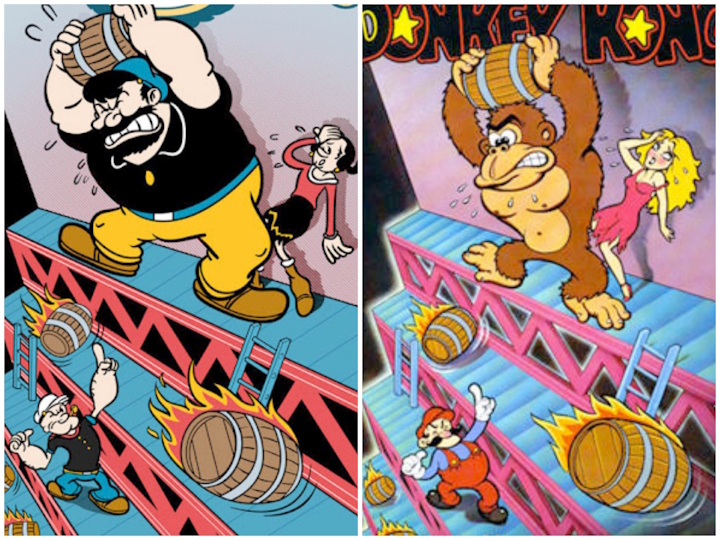
“Donkey Kong” derived from King Kong, and even though the character was in the public domain, Universal Studios still sued Nintendo over the use.
Ultimately the judge agreed with the Nintendo team and threw out the lawsuit, in an example of a giant corporation trying to steamroll what was at the time a small business with over-aggressive and illegitimate IP enforcement.
This was such an impactful moment for Nintendo that they took the name of their lawyer in the Universal Studios case — Kirby — and used it for the mascot of one of their biggest franchises. It was a significant move that demonstrates Nintendo’s extreme gratefulness — or even idolization — of the man who defended them against abuse of IP law.
You would hope the lesson Nintendo learned here would be from the perspective of the underdog, seeing as they were almost the victim of the kinds of tactics they would later become famous for using themselves. But no, it seems they were impressed by the ruthlessness of the abusers instead, and have since copied that playbook.
Apple puts its logo on the devices it sells. Not just on the outer casing, but also each internal component. The vast majority of these logos are totally enclosed and invisible to the naked eye.
This seems like an incredibly strange practice — especially since Apple doesn’t sell these parts separately — except it turns out to be part of a truly convoluted rules-lawyering exploit only a company like Apple could pull off and get away with.
Remember, trademarks are a consumer protection measure to defend against counterfeits. Apple’s registered logo trademark protects consumers from being tricked into buying fake products, and deputizes Apple to defend its mark against counterfeits.
But Apple has perfected the art of twisting this system to use it as a weapon against their opponents, and it is a nightmare.
(And I don’t just mean Apple asserting a monopoly over the concept of fruit, although it does do that also, all the time.)
The Loaded Gun
While some counterfeiting happens domestically the major concern is usually counterfeits imported from foreign trade. This brings us to Customs and Border Patrol, which you might know as the other side of the ICE/CBP border control system. You might be surprised to see them involved with this, since Border Patrol agents are fully-militarized police outfitted to combat armed drug cartels.
But among its other duties, Border Patrol takes a proactive role in enforcing intellectual property protection at ports of trade — backed by the full force of the Department of Homeland Security — by seizing goods it identifies as counterfeit and either destroying them outright or else selling them themselves at auction.1
To get your property back, you have to sue Border Patrol — an infamously untouchable police force — and win.

 Is AI eating all the energy? Part 1/2
 Monorail!
 Copyright abusers lost their claim

 Some games about grief
 maybe the textgen content apocalypse is great